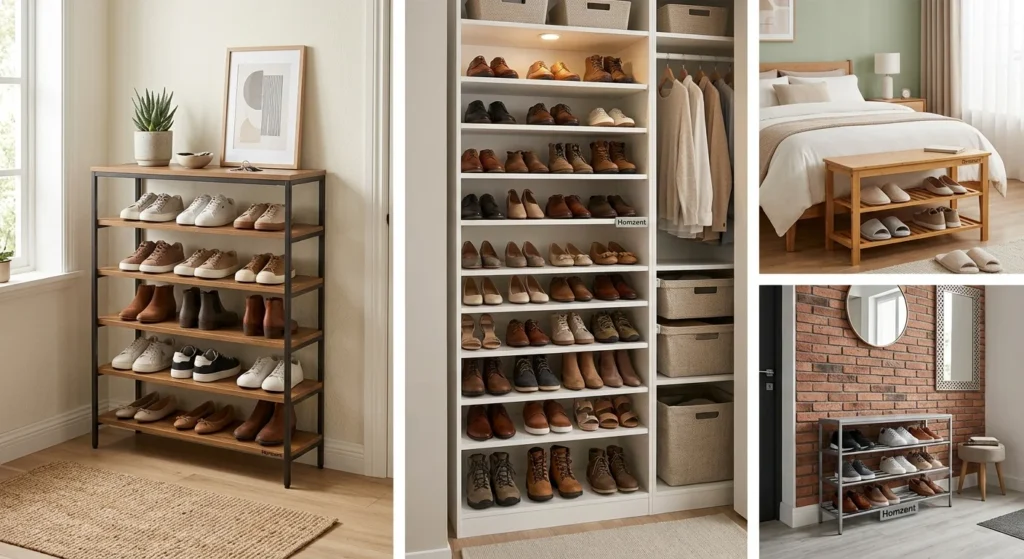
Finding the ideal shoe rack is essential for maintaining an organized, functional, and visually appealing home. From entryway benches and space-saving vertical towers to sleek, hidden cabinet storage, the right organizer keeps footwear accessible while protecting it from scuffs and dust.
This guide evaluates the best shoe racks on the market across key criteria—including storage capacity, structural durability, aesthetics, and ease of assembly. Whether you are maximizing a compact apartment footprint or curating a high-capacity closet system, explore top-rated picks designed to seamlessly blend utility with your decor.
- The global shoe rack market reached $3.08 billion in 2025 and is projected to hit $5.2 billion by 2034, growing at 5.99% annually (The Insight Partners, 2026).
- Shoe racks hold 28.4% of the total shoe storage market — the largest single category — because they balance affordability, visibility, and ease of use (Dataintelo, 2025).
- The best shoe rack depends on your space, shoe count, and lifestyle: open racks for daily access, closed cabinets for dust protection, stackable units for growing collections, and wall-mounted options for tight entryways.
- The average consumer now owns 18 to 25 pairs of shoes, up from 8 to 12 pairs in 2015, which drives demand for larger, more organized storage (Dataintelo, 2025).
- Plastic racks lead material sales at 41.3% due to low cost and moisture resistance, but wood and metal racks last longer and look better (Market.us, 2025).
What Is a Shoe Rack and Why It Matters in 2026
A shoe rack is a freestanding or mounted storage unit with horizontal shelves or tiers designed to hold multiple pairs of shoes in an organized, accessible, and space-efficient manner. It matters because shoe collections have grown while living spaces have shrunk. The average consumer now owns 18 to 25 pairs of shoes, up from 8 to 12 pairs in 2015 (Dataintelo, 2025). In urban apartments and compact homes, those 25 pairs become a clutter problem fast.
The global shoe rack market was valued at $3.08 billion in 2025 and is projected to reach $5.2 billion by 2034, growing at a compound annual growth rate of 5.99% (The Insight Partners, 2026). Within the broader shoe storage market — which includes cabinets, boxes, benches, and organizers — shoe racks hold the largest share at 28.4% (Dataintelo, 2025). They are the default choice because they are affordable, easy to assemble, and fit into entryways, bedrooms, closets, and garages without permanent installation.
A good shoe rack does more than line up shoes. It protects footwear from dust, moisture, and crushing. It keeps pairs matched and visible, which saves the morning hunt for a missing shoe. It also keeps floors clear, which matters in small spaces where every square foot counts. The right rack turns a scattered pile into a system.
How Shoe Racks Work: The 4-Type Framework
Shoe racks fall into four main categories based on structure and function. Picking the right type means matching the rack to your space constraints, shoe count, and how often you need access.
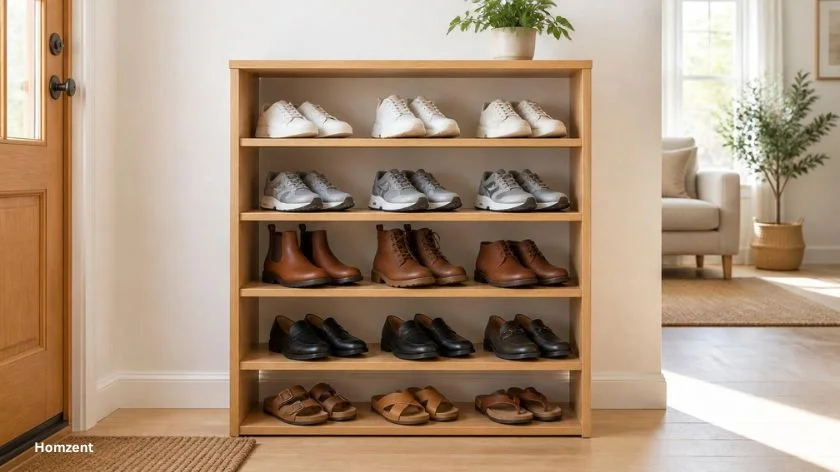
Open shoe racks are the most common. They have no doors or covers — just horizontal shelves or slanted tiers. You see every pair at a glance. They ventilate well, which prevents odor buildup. They are also the most affordable and easiest to assemble. Open racks held 37.9% of the shoe rack market in 2024 because they suit daily household use, rental homes, and compact apartments where convenience and airflow matter (Market.us, 2025). The downside is exposure to dust and pet hair.
Closed shoe racks have doors, covers, or fabric enclosures that hide shoes from view and protect them from dust. These are common in entryways where aesthetics matter — you do not want a wall of sneakers greeting guests. Closed racks also work for seasonal shoes you do not access daily. They cost more than open racks and take slightly more space due to the enclosure.
Stackable shoe racks use modular units that connect vertically. You buy a base unit and add tiers as your collection grows. This scalability appeals to growing households and people with limited floor space. Stackable designs also support DIY assembly and relocation, which matters for renters.
Wall-mounted shoe racks attach to vertical surfaces and keep the floor completely clear. They work in narrow entry corridors, small apartments, and mudrooms where floor space is nonexistent. Installation requires drilling and wall anchors, so they are less ideal for renters. Some designs fold flat against the wall when not in use.
Table
| Type | Best For | Pros | Cons |
|---|---|---|---|
| Open rack | Daily access, ventilation, tight budgets | Affordable, easy assembly, visible | Exposed to dust, no aesthetic cover |
| Closed rack | Entryways, dust protection, guest-facing areas | Clean look, protects shoes | Higher cost, takes more space |
| Stackable | Growing collections, renters, flexible layouts | Expands vertically, portable | Can become unstable if too tall |
| Wall-mounted | Tiny entryways, zero floor space | Frees floor completely | Requires drilling, limited capacity |
Open Shoe Racks: The Default Choice for Daily Use
Open shoe racks are the foundation of shoe storage. They are what most people picture when they think of a shoe rack: a simple frame with horizontal shelves.
Tier count determines capacity. A 3-tier rack holds 9 to 12 pairs. A 5-tier rack holds 15 to 20 pairs. A 10-tier tower holds 30 to 40 pairs. Match the tier count to your collection. If you own 20 pairs, a 5-tier rack works. If you share the rack with a partner, double the capacity or buy two units.
Materials vary by price and durability. Plastic racks dominate with 41.3% of material market share because they are lightweight, moisture-resistant, and cheap (Market.us, 2025). They work well in humid climates and garages. Wooden racks — bamboo, pine, oak — look better and last longer but cost more. They suit bedrooms and living areas where the rack is visible. Metal racks offer the highest load capacity and resist warping. They work for heavy boots and large collections.
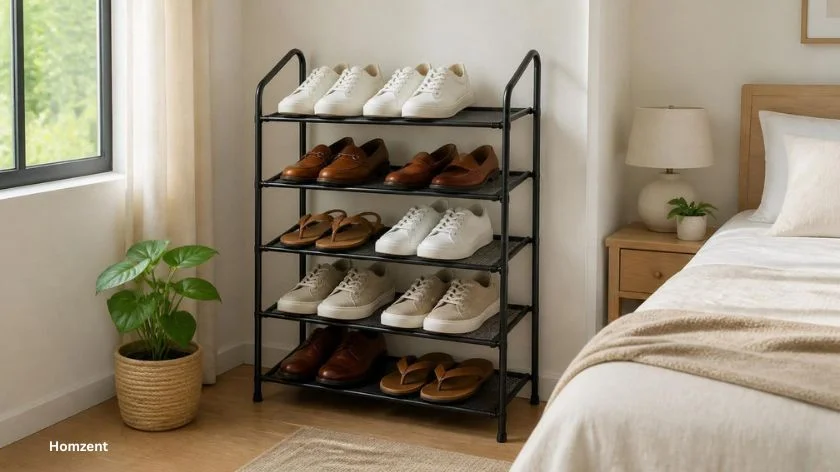
Shelf design matters. Flat shelves work for any shoe type but collect dust. Slanted shelves with a back lip display shoes at an angle and prevent them from sliding. Mesh or wire shelves allow dirt and moisture to fall through, which is useful for wet boots. Some racks have adjustable shelf heights to accommodate ankle boots or high-tops on one tier and flats on another.
Price range: Basic plastic 3-tier racks start at $15. Mid-range wooden or metal 5-tier racks run $40 to $80. Premium solid wood or designer metal racks reach $150 to $300.
Closed Shoe Racks and Cabinets: Dust Protection With Style
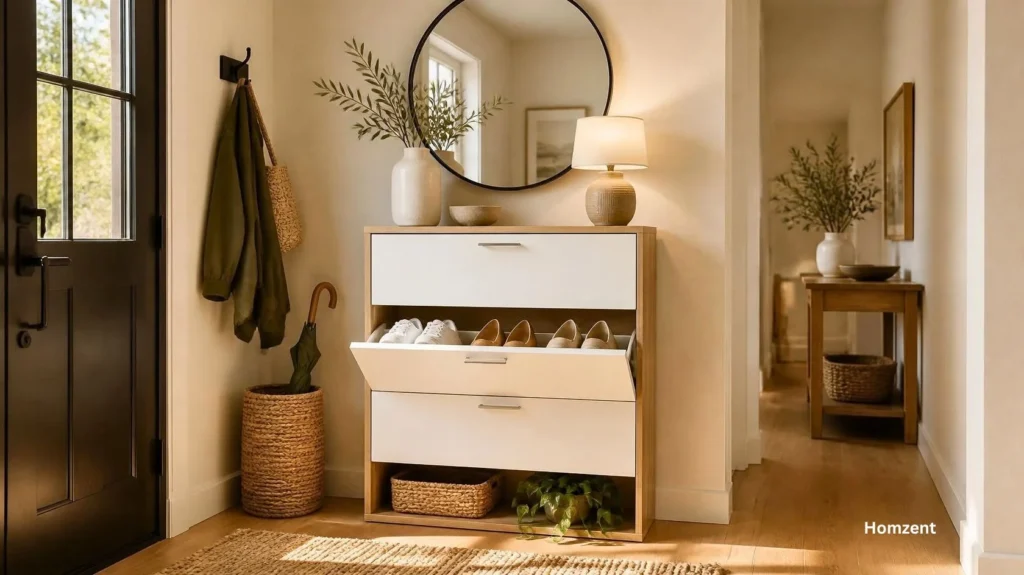
Closed shoe racks hide footwear behind doors, fabric covers, or tilt-out drawers. They are the choice when your shoe storage sits in a visible entryway or when you want to protect seasonal shoes from dust.
Tilt-out cabinets use horizontal drawers that tilt down to reveal shoes stored flat. A typical 2-drawer unit holds 12 to 16 pairs. These cabinets look like standard furniture — guests will not know they hold shoes. They work best in entryways and hallways.
Door-mounted organizers hang over the back of a closet or bedroom door with pockets or shelves for shoes. They are the cheapest closed option — $20 to $40 — and hold 12 to 24 pairs depending on pocket count. The downside is that shoes are compressed against the door, which can misshape soft materials over time.
Fabric enclosures zip or velcro around a wire or plastic frame. These are lighter than wood cabinets and cheaper than solid furniture. They cost $25 to $60 and hold 12 to 30 pairs. The fabric keeps dust out but can tear and is harder to clean than a wipeable surface.
Solid wood or laminate cabinets are the premium closed option. A tall cabinet with 4 to 6 shelves behind a single door holds 20 to 30 pairs. Some include a bench top for sitting while putting on shoes. These units cost $150 to $400 and function as entryway furniture, not just storage.
The broader shoe cabinet segment holds 24.2% of the shoe storage market, driven by consumers who want concealed, organized, dust-free storage that aligns with modern interior aesthetics (Dataintelo, 2025).
Stackable and Expandable Shoe Racks: Growing With Your Collection
Stackable shoe racks solve the problem of outgrowing your storage. Instead of replacing a rack when you buy more shoes, you add another tier or connect a second unit.
Interlocking plastic tiers are the most common stackable design. Each tier is a separate rectangle that snaps onto the one below. A single tier holds 3 pairs. Stack five for 15 pairs. Stack ten for 30 pairs. The modularity means you can split the stack into two shorter units if you move to a smaller space.
Wire cube systems use square wire frames that connect with plastic corner joints. Each cube holds 2 to 3 pairs. You can build vertically, horizontally, or in an L-shape to fit a corner. These systems are popular for closets because they adapt to odd dimensions.
Stackable boxes are individual clear plastic containers that stack like building blocks. Each box holds one pair. The clear front lets you see the shoe without opening the box. This is the most protective stackable option — shoes stay dust-free and uncrushed. The downside is that accessing a pair at the bottom of a tall stack requires unstacking boxes above it.
Best use case: Stackable systems work for people with growing collections, renters who may move frequently, and anyone who wants to start small and expand later. They also work for families where each person gets their own stackable unit.
Wall-Mounted Shoe Racks: Zero Floor Space Required
Wall-mounted shoe racks attach to studs or drywall anchors and keep footwear off the floor entirely. They are the only option when floor space is literally unavailable.
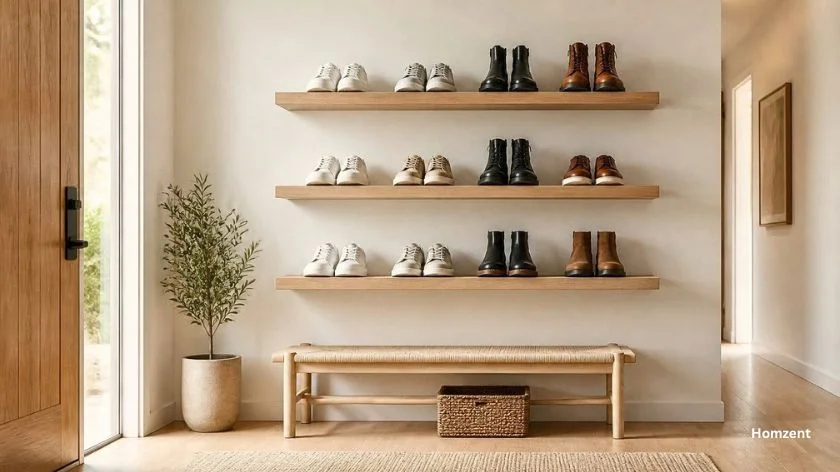
Floating shelves are the simplest wall-mounted solution. A 36-inch shelf mounted at shoe height holds 4 to 6 pairs. Install two or three shelves vertically and you have a full shoe wall. This looks clean and modern but exposes shoes to dust. It works best for display-worthy collections — designer sneakers, leather boots — rather than everyday beaters.
Wall-mounted wire racks use a grid or basket system that attaches to a horizontal rail. Shoes sit in individual baskets or on small platforms. These systems hold more pairs per square foot than shelves because they use depth as well as width. A 4-foot rail with 8 baskets holds 8 to 16 pairs.
Fold-down racks attach to the wall and fold flat when not in use. Pull the rack down to access shoes, then fold it back up to clear the walkway. These are common in tiny European apartments and Japanese entryways. They cost $40 to $100 and hold 6 to 12 pairs.
Behind-the-door racks hang over the closet or bedroom door. They are technically not wall-mounted — no drilling required — but they serve the same purpose of using vertical space. Most hold 12 to 24 pairs in pockets or on small shelves. The pockets compress shoes, so avoid using them for leather or structured footwear that needs to keep its shape.
Installation tip: Always locate wall studs for heavy loads. If mounting on drywall without a stud, use toggle bolts rated for at least 50 pounds per anchor. A full rack of shoes is heavier than it looks.
Shoe Rack Materials: Plastic, Wood, Metal, and Fabric
The material of your shoe rack affects its durability, appearance, weight, and how it interacts with moisture and dust.
Plastic leads the market with 41.3% of material share because it is cheap, lightweight, and resists moisture (Market.us, 2025). Plastic racks work in humid climates, garages, and bathrooms. They are easy to clean — just wipe with a damp cloth. The downside is that cheap plastic warps under heavy boots and can crack if moved frequently. Look for high-density polypropylene, not brittle PVC.
Wood offers the best appearance and a long lifespan. Bamboo is a popular choice because it is sustainable, moisture-resistant, and affordable. Solid hardwoods like oak and walnut cost more but last decades. Wood racks suit bedrooms, living areas, and entryways where the rack is part of the room’s design. Avoid placing untreated wood in damp areas — it will swell and mold.
Metal provides the highest strength and load capacity. Steel and iron racks handle heavy work boots, hiking shoes, and large collections without sagging. Powder-coated metal resists rust. Metal works in garages, mudrooms, and industrial-style interiors. The downside is weight — a metal rack is harder to move than plastic or wood.
Fabric is used in lightweight, portable racks with a metal or plastic frame and a fabric cover. These are the cheapest option — $15 to $40 — and work for temporary storage or dorm rooms. Fabric tears easily, absorbs odors, and is hard to clean. Treat it as a short-term solution, not a permanent fixture.
Table
| Material | Market Share | Best For | Avoid |
|---|---|---|---|
| Plastic | 41.3% (Market.us, 2025) | Humid areas, garages, tight budgets | Heavy boots, frequent moving |
| Wood | ~25% | Visible rooms, long-term use | Damp areas without treatment |
| Metal | ~20% | Heavy shoes, large collections, garages | Small spaces where weight matters |
| Fabric | ~10% | Temporary, dorm rooms, travel | Long-term, high-traffic use |
How to Choose the Right Shoe Rack for Your Space
Step 1: Count your shoes. Include seasonal pairs stored elsewhere. If you own 20 pairs, you need a rack that holds at least 20 — or 24 to 30 if you plan to buy more. Undersizing is the most common mistake.
Step 2: Measure your space. Record the width, depth, and height of the area where the rack will live. Account for door swing, walkway clearance, and closet depth. A rack that is too deep blocks a hallway. A rack that is too tall hits a shelf.
Step 3: Decide on visibility. Do you want shoes visible and accessible, or hidden and protected? Daily wearers belong on an open rack. Seasonal and special-occasion shoes belong in a closed cabinet or box.
Step 4: Consider your environment. Humid climates favor plastic or treated wood. Dry climates work with any material. Garages and mudrooms need metal or heavy-duty plastic. Bedrooms and entryways can use wood or decorative metal.
Step 5: Set your budget. Entry-level plastic racks cost $15 to $30. Mid-range wood or metal racks run $50 to $150. Premium cabinets and solid wood systems reach $200 to $500. The average household spends $50 to $100 on a primary shoe rack.
Step 6: Check assembly requirements. Most racks require 10 to 30 minutes of assembly with a screwdriver or Allen key. Wall-mounted racks need a drill and stud finder. If you are not handy, choose a pre-assembled unit or pay for assembly.
Common Mistakes to Avoid When Buying a Shoe Rack
- Buying too small: A rack that holds 12 pairs when you own 20 guarantees overflow. Count every pair, including seasonal shoes, then add 20% for future purchases.
- Ignoring depth: A rack that is 12 inches deep will not fit men’s size 12 boots, which need 14 to 16 inches. Check shoe dimensions, not just pair count.
- Placing wood in damp areas: Untreated wood swells, warps, and molds in bathrooms, garages, and humid entryways. Use plastic or metal in these spots.
- Stacking too high: A stackable unit that reaches 6 feet tall becomes unstable and hard to access. Split into two shorter stacks or anchor to a wall.
- Forgetting about heel height: High heels need shelves with a back lip or enclosed sides to prevent tipping. Flat shelves work for sneakers and flats but not for stilettos.
- Overlooking ventilation: Shoes need airflow to prevent odor buildup. Fully enclosed cabinets without ventilation holes trap moisture and smell. Choose cabinets with small vents or leave the door slightly ajar.
At Homzent, we believe that the best shoe rack should do more than organize footwear—it should make everyday life easier, maximize your available space, and complement your home’s style. That’s why every recommendation in this guide is based on careful research, practical home organization principles, and real-world buying considerations rather than marketing claims alone.
Experience
Our content is created with everyday homeowners, renters, and families in mind, focusing on practical storage solutions that work in real living spaces.
Example 1: For a small apartment entryway, a slim vertical shoe rack can keep 12–18 pairs of shoes organized while taking up minimal floor space.
Example 2: In a family home, a large multi-tier shoe rack placed near the front door helps separate children’s, guests’, and everyday footwear, making busy mornings more organized.
Expertise
We evaluate shoe racks using the factors that matter most for long-term performance, including material quality, weight capacity, ventilation, storage capacity, ease of assembly, and overall value.
Example 1: A powder-coated steel shoe rack is generally a better choice for storing heavy boots because it offers greater strength and resists rust over time.
Example 2: Bamboo shoe racks are ideal for bedrooms and closets because they combine natural durability with a stylish appearance while allowing airflow to help reduce moisture buildup.
Authoritativeness
Our recommendations are informed by trusted home organization practices, current furniture trends, and feature comparisons that help readers make confident buying decisions.
Example 1: We compare open shoe racks, closed shoe cabinets, stackable organizers, and bench-style shoe racks so readers can choose the design that best fits their space.
Example 2: We highlight practical features such as adjustable shelves, expandable designs, and non-slip feet to help readers select a shoe rack that meets both current and future storage needs.
Trustworthiness
We are committed to providing honest, unbiased guidance. Our goal is to help readers choose the right shoe rack based on their needs—not simply recommend the most expensive option.
Example 1: If an affordable shoe rack performs well for sneakers and casual shoes but isn’t designed for heavy-duty use, we clearly explain that limitation.
Example 2: If a premium wooden shoe rack offers better durability, craftsmanship, and long-term value, we explain why the higher price may be worthwhile for certain households.
Our Editorial Promise
Every recommendation published on Homzent is written to help readers make informed decisions with confidence. We prioritize accuracy, practical advice, and user-first content so you can choose the best shoe rack for your home based on reliable information—not advertising or hype.
Frequently Asked Questions About Shoe Racks
What is the best shoe rack for a small entryway?
A wall-mounted rack or a narrow 3-tier open rack works best. Wall-mounted options free the floor entirely. A 3-tier rack 24 inches wide and 12 inches deep fits most entryways without blocking traffic.
How many pairs of shoes does the average person own?
The average consumer now owns 18 to 25 pairs, up from 8 to 12 pairs in 2015 (Dataintelo, 2025). This growth drives demand for larger, more organized storage systems.
What is the most durable material for a shoe rack?
Metal, specifically powder-coated steel, offers the highest durability and load capacity. Solid hardwoods like oak and walnut also last decades but cost more and need climate control.
Are closed shoe racks better than open ones?
Closed racks protect shoes from dust and look cleaner in visible spaces. Open racks provide better ventilation and faster access. The best choice depends on where the rack sits and how often you access the shoes.
Can shoe racks hold boots?
Yes, but check shelf height. Ankle boots need 6 to 8 inches of vertical clearance. Knee-high boots need 18 to 20 inches or should be stored lying flat. Some racks have adjustable shelves to accommodate mixed collections.
How much should I spend on a shoe rack?
Basic plastic racks cost $15 to $30. Mid-range wood or metal racks run $50 to $150. Premium cabinets and solid wood systems reach $200 to $500. Most households find the sweet spot at $50 to $100 for a primary rack.
Do shoe racks work in closets?
Yes. Stackable units, hanging organizers, and narrow tiered racks are designed specifically for closet use. Measure your closet depth — standard closets are 24 inches deep, but reach-in closets may be only 20 inches.
Final Thought
A clutter-free home begins with smart, functional storage solutions that suit your lifestyle. Investing in the right shoe rack not only protects your favorite footwear from wear and tear, but it also elevates your entryways and closets into clean, welcoming spaces you love coming home to.
At Homzent, we design thoughtful home organization pieces that seamlessly balance premium durability, sleek aesthetics, and everyday practicality. Ready to transform your living spaces? Explore the complete Homzent collection today to discover storage solutions crafted to keep your home effortlessly organized.