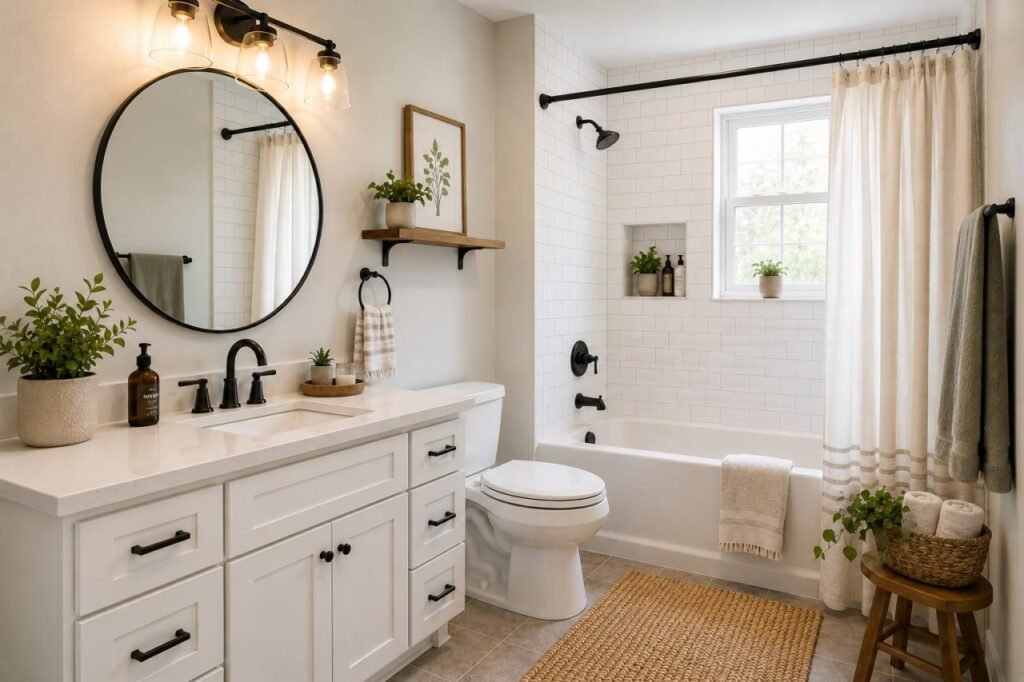
Bathroom Remodel Ideas On a Budget
Most bathroom remodel articles hand you a list of pretty ideas without ever mentioning what any of it costs, or which of those ideas are actually worth your limited budget. That’s a problem, because a budget bathroom remodel isn’t really about finding cheap ideas, it’s about knowing exactly where your money makes the biggest visible difference.
A full professional bathroom remodel averages somewhere around $12,000, with most projects landing between $2,500 and $30,000 depending on scope. That’s a wide enough range that “budget” means something very different depending on whether you’re refreshing a small guest bath or gutting a primary bathroom down to the studs.
At Homzent, we think the most useful thing we can do here isn’t hand you another list of ideas, it’s help you understand where your money goes, what’s safe to skip, and which low-cost swaps deliver the most visible change per dollar spent.
What a Bathroom Remodel Actually Costs
Before deciding what to prioritize, it helps to know where the money typically goes in the first place.
- Labor usually accounts for 40 to 60% of total project cost, which is exactly why DIY-friendly tasks save the most money.
- Demolition typically runs $1,000 to $2,500, and is one of the more DIY-friendly tasks for anyone comfortable with basic tools.
- Plumbing ranges from $2,000 to $10,000, with simple fixes on the low end and layout changes pushing costs much higher.
- A basic toilet can be found for as little as $125, with a full install typically landing between $375 and $500.
- Small bathroom remodels (guest baths, powder rooms) often fall between $5,000 and $15,000, while primary bathrooms with more square footage and higher-end finishes can push well past $30,000.
Seeing these numbers side by side makes one thing clear: layout changes and plumbing moves are where budgets blow up, while surface-level updates, paint, hardware, fixtures, are where the real budget-friendly wins live.
Build In a Cushion Before You Start
Professional contractors and design publications consistently recommend setting aside 20 to 30% of your budget as a contingency before you even start shopping for materials.
This isn’t pessimism, it’s realism. Around a third of homeowners in recent renovation surveys reported spending more than expected, most often because of plumbing surprises, water damage, or structural issues discovered once walls are opened up. Planning for this upfront means an unexpected expense doesn’t derail the whole project or force a compromise on the parts of the remodel you actually cared about.
If your total budget is $5,000, treat $3,500 to $4,000 as your real spending budget and hold the rest in reserve. If nothing goes wrong, that reserve becomes extra room for a nicer faucet or tile at the end instead of a stressful mid-project cutback.
Where to Splurge and Where to Save
Not every part of a bathroom remodel deserves equal budget attention. A few areas consistently deliver more visible impact and value than others.
Worth spending more on:
- The shower or tub, since it’s usually the room’s largest visual and functional feature
- The vanity and countertop, which sits at eye level and gets touched daily
- Flooring, since it’s difficult and expensive to redo again soon after
Safe to save on:
- Lighting fixtures, which are relatively inexpensive to upgrade later without disrupting anything else
- Decorative hardware, which can be swapped again cheaply as styles change
- Paint color, which costs the same whether it’s trendy or timeless
A useful rule of thumb: prioritize whatever would be most disruptive and expensive to change again in a year or two, and treat the rest as flexible, low-stakes decisions.
Refinish Instead of Replace
This is arguably the single highest-value strategy in a budget bathroom remodel, and it’s consistently underused.
- Refinish the bathtub instead of replacing it. A tub refinishing kit or professional reglazing service costs a fraction of a full tub replacement and can make a dated or stained tub look brand new.
- Paint the vanity instead of buying a new one. The vanity is often the most expensive single piece of furniture in a bathroom; a fresh coat of paint and new hardware can transform it for a small fraction of replacement cost.
- Reglaze or resurface tile instead of removing it. Removing and replacing tile is labor-intensive and expensive; resurfacing existing tile is a far cheaper way to update an outdated color or finish.
- Refinish cabinets rather than replacing the boxes. Keeping the existing cabinet structure and updating only the doors, paint, and hardware preserves most of the visual impact at a fraction of the cost.
Smart Material Swaps That Cut Costs
Material choice is one of the biggest budget levers in any bathroom remodel, often more than people expect.
- Choose peel-and-stick tile over traditional tile. It’s significantly cheaper, doesn’t require specialized installation, and works well for renters or anyone wanting a quick, reversible update.
- Tile one surface, not both. Tiling either the walls or the floor, rather than both, cuts material and labor costs substantially while still delivering a finished, intentional look.
- Use vinyl or laminate instead of stone. These materials cost a fraction of natural stone and hold up well in bathroom conditions, especially for budget-conscious floor or wall updates.
- Try faux marble contact paper on countertops. This won’t last as long as real stone, but it’s an inexpensive, waterproof way to cover a dated or damaged countertop while the rest of the budget goes elsewhere.
Small Fixture Updates With Big Visual Payoff
Some of the least expensive changes in a bathroom remodel also happen to be some of the most noticeable.
- Swap all hardware and fixtures together. Updating the vanity hardware, faucet, showerhead, and towel bar in the same finish creates a cohesive, intentional look, even if nothing else in the room changes.
- Add an oversized mirror. Beyond making the room feel larger, a bigger mirror is one of the most cost-effective visual upgrades available in a budget remodel.
- Repaint in a lighter color. Light, neutral tones make a small or dated bathroom feel larger and more current, and paint remains one of the cheapest changes per square foot in the entire remodel.
- Update the light fixture. A dated fixture can make an otherwise updated bathroom feel unfinished, while a simple swap is inexpensive and usually doesn’t require professional help.
DIY vs. Hiring a Contractor for a Budget Remodel
| Factor | DIY Approach | Hiring a Contractor |
| Materials Cost | Roughly $75 to $100 per square foot | Roughly $175 to $225 per square foot |
| Labor | Your own time and effort | Typically 40 to 60% of total project cost |
| Best For | Paint, hardware swaps, peel-and-stick tile, vanity refinishing | Plumbing changes, layout changes, tile installation, tub replacement |
| Risk | Higher chance of costly mistakes on plumbing or structural work | Lower risk, but higher upfront cost |
| Timeline | Flexible, but often slower around other commitments | Faster, with a defined project timeline |
Most budget remodels benefit from a hybrid approach: DIY the surface-level updates, paint, hardware, minor tile work, while hiring a professional for anything involving plumbing, electrical, or structural changes.
Common Budget Bathroom Remodel Mistakes to Avoid
Skipping the contingency fund. Starting a remodel with every dollar already allocated leaves no room for the plumbing or water damage surprises that show up in roughly a third of projects.
Replacing when refinishing would work. Tubs, tile, and cabinets are often replaced out of habit rather than necessity, when a fraction of the cost could achieve a similar visual result.
Tiling both the floor and walls on a tight budget. This doubles both material and labor costs; choosing one surface to tile and keeping the other simpler stretches the budget significantly further.
Underestimating labor costs. Since labor often makes up 40 to 60% of total project cost, underestimating this line item is one of the fastest ways to blow through a budget.
Prioritizing trendy fixtures over structural needs. Spending heavily on statement fixtures while ignoring plumbing or water damage issues can lead to bigger, more expensive problems down the line.
Frequently Asked Questions
How much does a budget bathroom remodel cost?
A budget-conscious remodel for a small bathroom often falls between $5,000 and $15,000, while a full professional remodel across all bathroom sizes averages around $12,000, with a typical range of $2,500 to $30,000 depending on scope and finishes.
What should I prioritize in a bathroom remodel on a budget?
Focus your budget on the shower or tub, the vanity, and flooring, since these are the most visible, most used, and most expensive to redo again soon. Lighting, hardware, and paint are safer areas to save on, since they’re inexpensive to update later.
Is it cheaper to refinish or replace a bathtub?
Refinishing is significantly cheaper than replacing a bathtub in most cases, and a tub refinishing kit or professional reglazing service can make an old or stained tub look new again for a fraction of replacement cost.
How much should I budget for unexpected costs in a bathroom remodel?
Most experts recommend setting aside 20 to 30% of your total budget as a contingency, since plumbing issues, water damage, or structural surprises are common once walls are opened up during a remodel.
What is the cheapest way to update a bathroom?
Painting the walls and vanity, swapping hardware and fixtures, adding an oversized mirror, and using peel-and-stick tile are among the least expensive updates that still make a noticeable visual difference.
How much does labor cost in a bathroom remodel?
Labor typically accounts for 40 to 60% of total bathroom remodel costs, which is one of the main reasons DIY-friendly tasks, like painting or hardware swaps, offer some of the biggest budget savings.
Should I tile both the floor and walls in a budget bathroom remodel?
Tiling only one surface, either the floor or the walls, rather than both, is a common budget strategy that significantly reduces material and labor costs while still delivering a finished look.
Is a DIY bathroom remodel cheaper than hiring a contractor?
Yes, DIY materials alone typically run $75 to $100 per square foot compared to $175 to $225 per square foot with a contractor, though plumbing, electrical, and structural work generally still calls for a licensed professional.
What adds the most value to a budget bathroom remodel?
Fresh paint in a light, neutral color, an updated vanity or refinished existing one, and new lighting or mirror hardware tend to offer the best return relative to cost, since they’re highly visible changes that don’t require structural work.
Final Thoughts
A bathroom remodel on a budget isn’t about finding the cheapest version of every idea, it’s about understanding where your money actually shows up in the finished room, and where it quietly disappears into plumbing and labor no one will ever see. Refinishing instead of replacing, tiling one surface instead of two, and building in a real contingency fund will stretch a modest budget further than almost any single design choice.
Start by identifying your one or two non-negotiables, whether that’s a new shower or a working vanity, and let the rest of the budget flow around those priorities. That’s the kind of practical, cost-aware thinking we try to bring to every guide at Homzent.