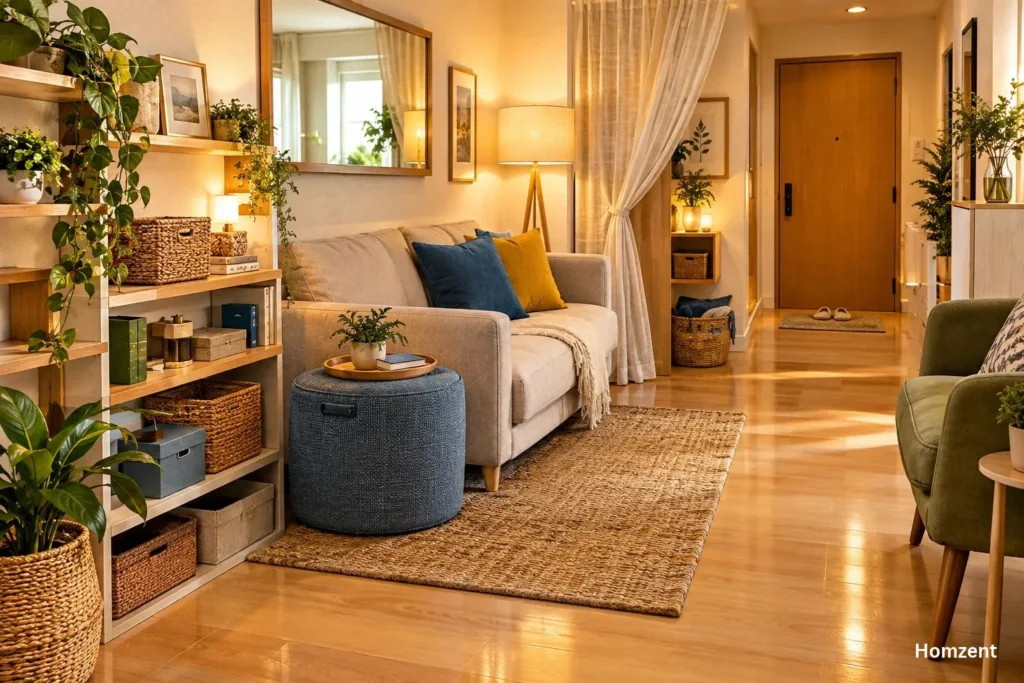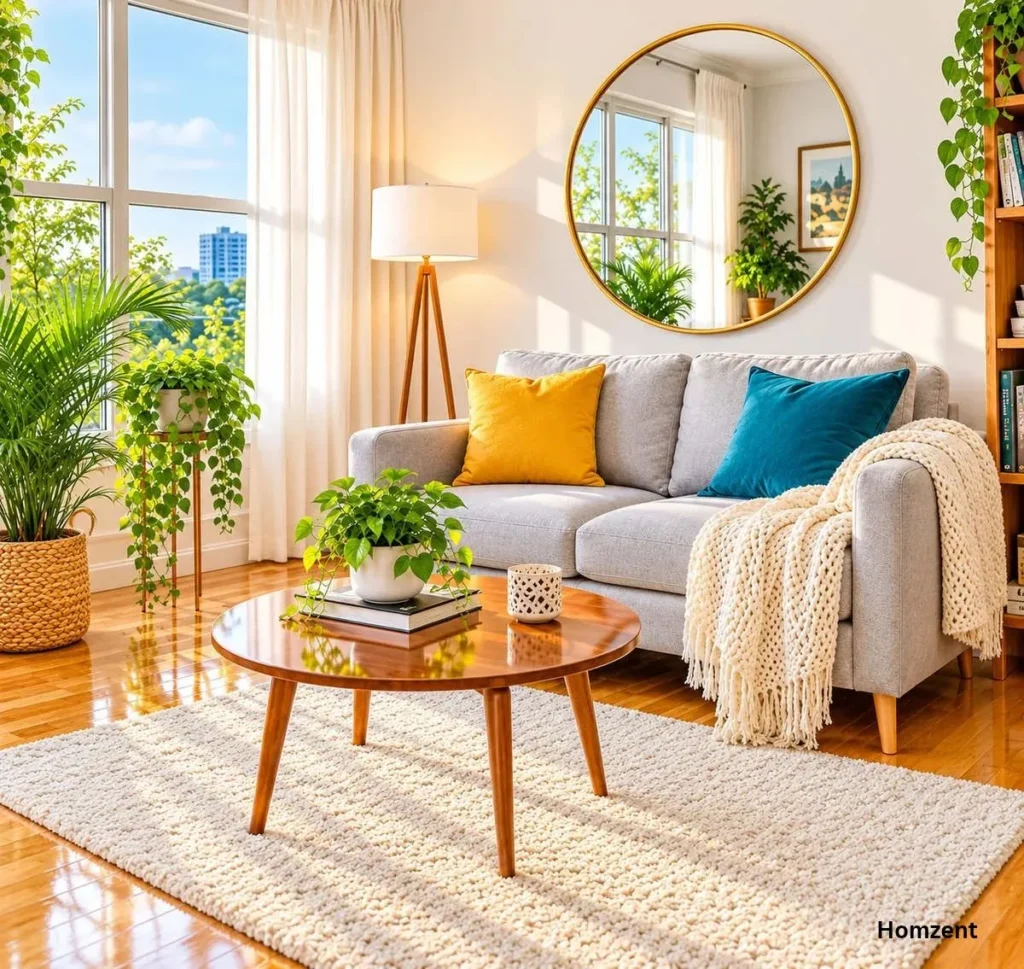
Small living room decor ideas work when they shrink what sits on the floor and stretch what the eye sees: compact furniture that does two jobs, storage that climbs the walls, light from several heights, pale colors and reflective glass, all placed according to a plan you measure before you shop.
For years, the standard advice for a cramped room was to push everything against the walls and buy less. That rule misses the point. A room looks bigger when the layout supports easy flow, when furniture scale suits the walls, and when one focal point gives the eye somewhere to land.
The biggest gains rarely need a renovation. Pieces that pull double duty, a weekend spent decluttering, and shelves that use vertical space usually fit a modest budget. They also change the before-and-after photos more than a new sofa does.
Light shapes everything else. Natural light makes a room brighter and more airy, while a few versatile lamps set the evening mood. Smart lighting controlled from an app or remote controls is a bonus when you separate the room into zones, not a requirement.
Above all, decorate for what the room needs. A small room with character feels finished long before it feels full.
How Should You Lay Out a Small Living Room?
Lay out a small living room by measuring every wall first, choosing one anchor for the seating to face, and protecting the walking paths before placing a single accessory.
A tiny living room in a condo often shares its space with the kitchen, the dining area and the door to the balcony. That makes the plan a traffic problem before it is a style problem. Every bit of square footage you can’t walk through is wasted space.
A reliable order for planning a small room looks like this:
Measure twice. Measure each wall, window and door swing, then measure again. Never eyeball whether furniture will fit.
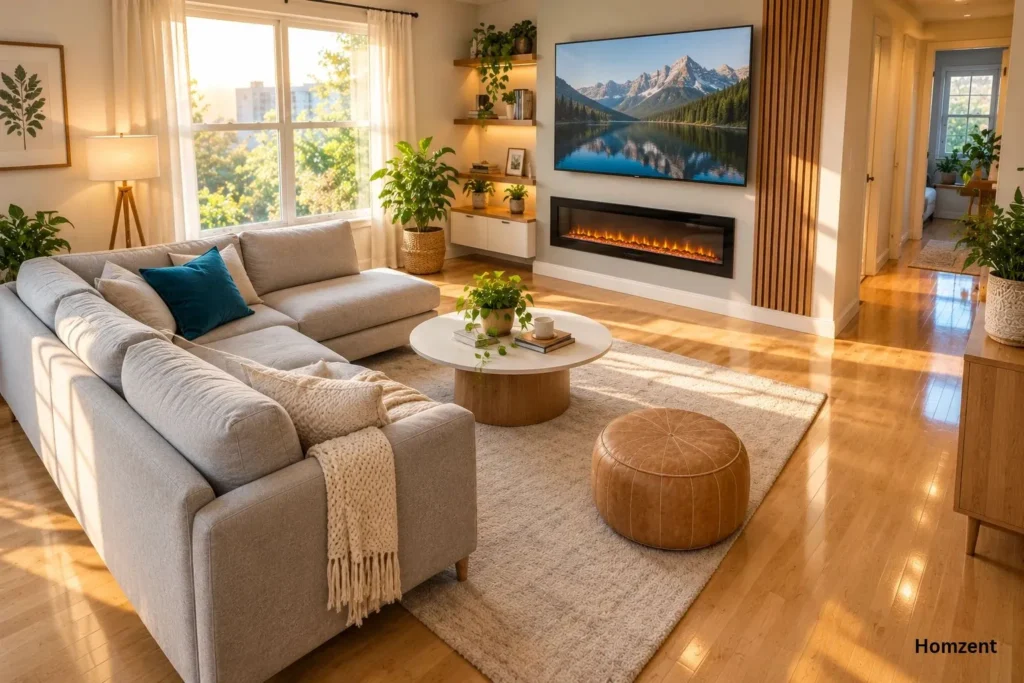
Choose the anchor. Without a real hearth, an electric fireplace needs no venting or chimney. A linear model can sit below a wall-mounted TV and adds supplemental heat in colder climates.
Set the edge. An L-shaped sofa with its back to the walkway helps distinguish the lounge from the rest of the space.
Add flexible seats. A round coffee table is easy to step around and leaves room for extra seating on nights of entertaining.
Confirm the numbers. Double-check every listing before you buy.
The finished plan should serve everyday lounging first: a spot to kick up your feet, a clear path and nothing to step over. That is what makes a room feel intentional. On a media wall, the cords and cables that drop from a wall-mounted TV can be gathered behind a low console, and a shallow tray of river rocks on top hides whatever still shows, so the wall reads as decor instead of wiring.
What Furniture Works Best in a Small Living Room?
The furniture that works in a small living room is compact, raised on slim supports and does more than one job, sized to the room so the walkways stay clear.
Small-room shoppers tend to fear two opposite mistakes, and both are real. Oversized pieces crowd the floor, while undersized chairs leave the room looking sparse and disjointed. The fix is to measure against the room’s dimensions, not against a showroom floor.
These swaps make the biggest difference in tight rooms:
| Common choice | Smaller-room swap | What you gain |
| A massive sofa or deep sectional sofa | A loveseat with low arms and a low back | Wall space above for a large mirror |
| A bulky extra club chair | A chaise lounge or one accent chair | A seat without a big footprint |
| Freestanding side cabinets | Storage benches with hidden compartments | Room for essentials plus seating |
Symmetry calms a busy room. Matching armchairs that mirror each other across a small table give the room parallel structure, so it reads as orderly even when every seat is taken.
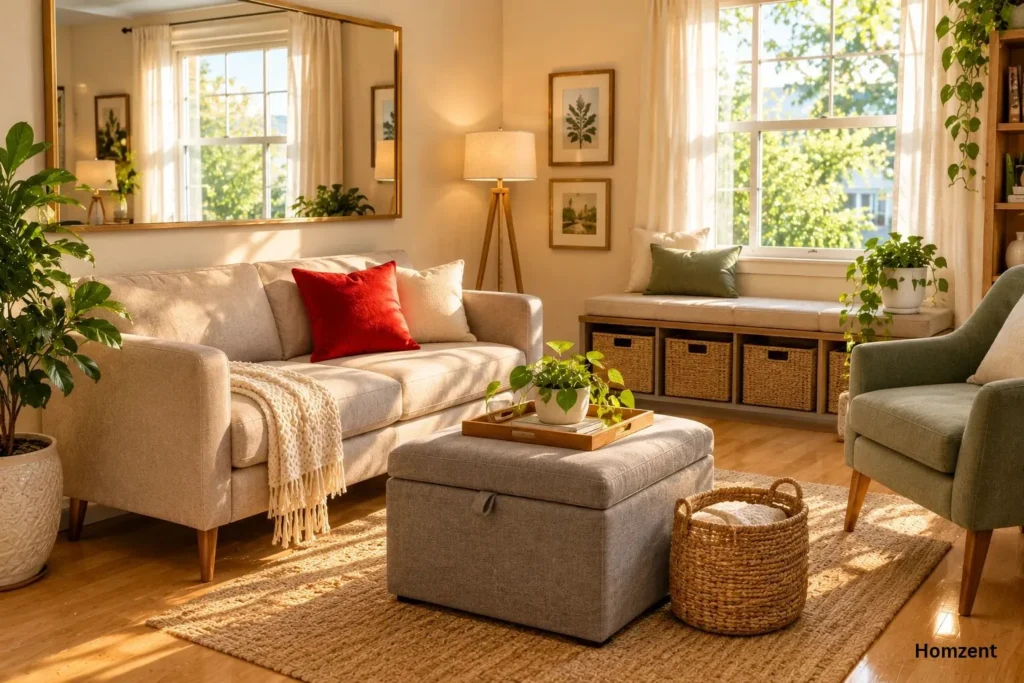
Keep strong color on things you can swap. A bright red throw pillow or a green throw adds energy without locking a large piece into a loud fabric.
Move bulky items up into wall cabinets, and choose multifunctional furniture that stays functional on a quiet Tuesday, not only on party nights.
How Do You Add Storage Without Cluttering a Small Living Room?
Add storage to a small living room by building up the walls and choosing furniture with storage built in, so belongings disappear without new pieces on the floor.
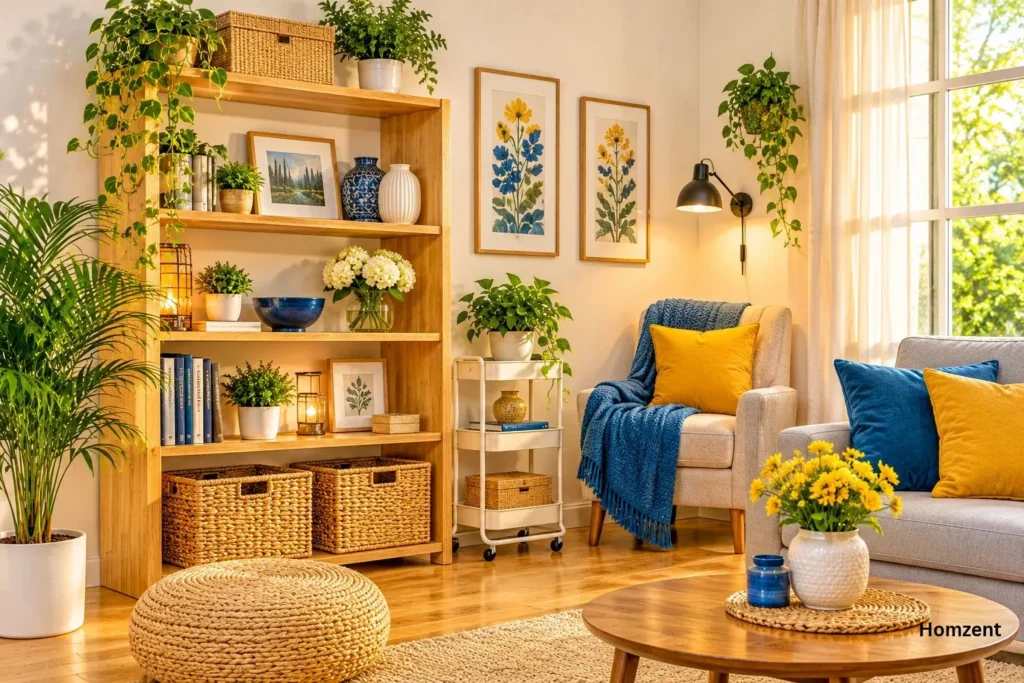
Start with the furniture you already sit beside. A pouf with storage, ottomans with lids, a coffee table with shelves and nesting tables that tuck under each other all offer hidden storage in spots you use every day. A slim trolley can hold chargers near the TV and roll out of the way.
Clever storage also starts with checking wall heights. One tall shelving unit holds more than two short chests, and drawer inserts keep the open shelves from looking chaotic.
Tall bookshelves can double as room dividers and create a light room border. Add a clip-on spotlight or bookcase and cabinet lighting, and that corner becomes a reading nook that invites real reading.
To zhuzh a shelf, skip the scattered single items and group a few smaller ones together, such as frames, bowls and little plants. Fewer, grouped objects cut mental clutter and make the room look put-together.
How Can You Divide a Small Living Room Into Zones?
Divide a small living room into zones with furniture placement, textiles and light, so each activity gets its own area without new walls.
Lining every piece along the walls can create dead zones in the middle of the room. Try to float the sofa a step forward with a console table behind it. That quietly splits the seating from the walk-through space.
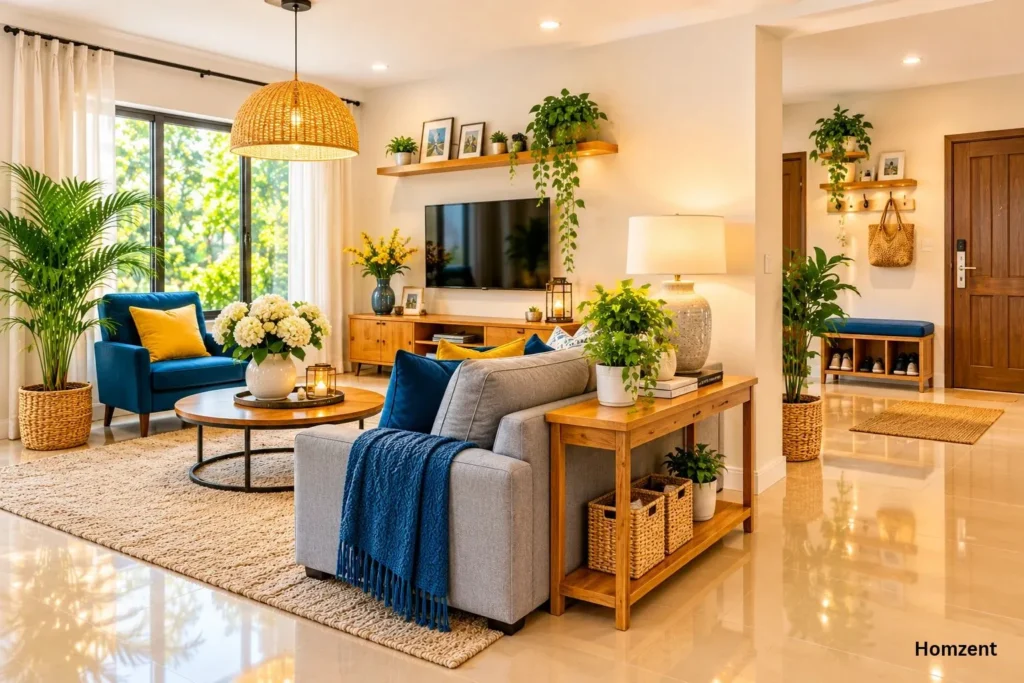
Doors help too. Sliding doors on storage furniture hide a screen or a stack of boxes, so an entertainment hub turns into a calm lounge when guests arrive. By the entryway, a bench over shoe cubbies keeps shoes from drifting toward the seating area.
Light and color can mark zones without any construction. Pendants over the seating and a table lamp at one end of the sofa create a snug ambiance. A two-toned wall with deep blue on the lower half, or contrasting elements like dark textiles on pale floors, sets areas apart visually.
For overnight guests, a sofa bed converts the lounge, and a lightweight side table goes wherever it’s needed. That layered setup keeps open spaces livable. Sketch it on a floor plan before doing any rearranging.
What Lighting Makes a Small Living Room Feel Bigger?
Lighting makes a small living room feel bigger when light comes from several heights at once, leaving no shadowy corner to shrink the room.
A single overhead fixture leaves the edges dark and dingy. Light coming from overhead, from the walls and from the tabletops can bounce off pale surfaces and reflect light across the room. That alone makes a space feel more dynamic, no design show makeover required.
Bulb color also changes how paint looks, so it’s worth testing bulbs before you commit to a wall color:
| Light source | Effect on paint color | Best spot |
| Daylight from windows | Shows hues in their truest shades | Seating facing the glass |
| Soft yellowish bulbs | Makes colors look richer | Lamps near seating |
| Bluish-white bulbs | Gives a crisper, more modern feel | Work and storage corners |
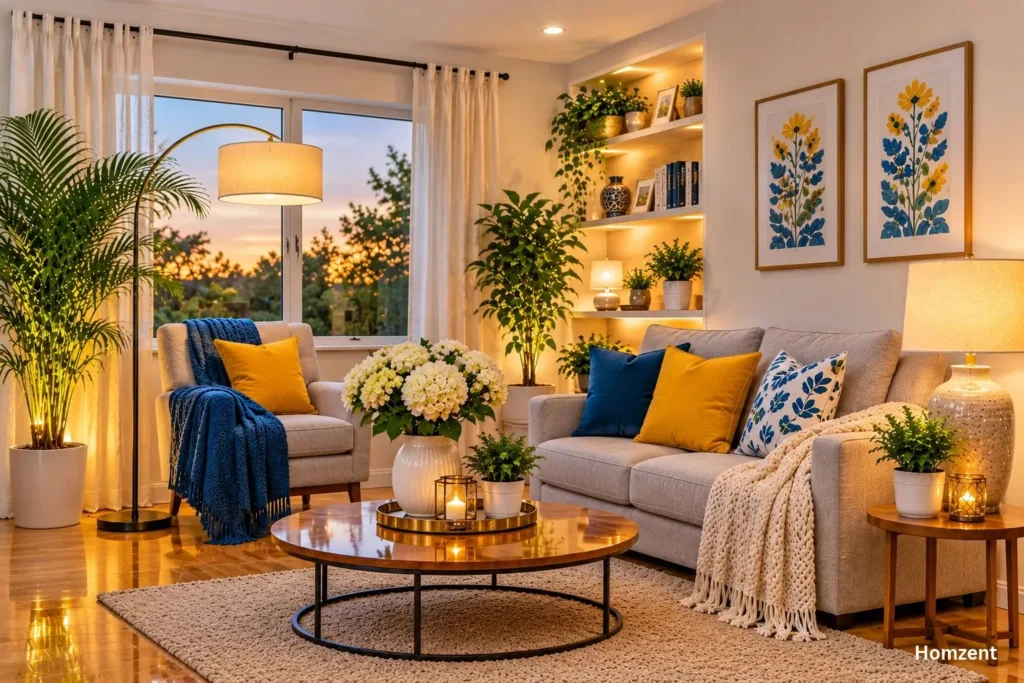
Accent lights do decorative work too. A small lamp on built-in shelves highlights collections, figurines and candles, so the shelf-styling looks deliberate. A small uplight placed on the floor behind a plant stand of potted plants throws leaf shadows onto the wall and makes that corner feel cozy.
Watch the windows: heavy curtains block daylight, so keep them open. A lamp beside the armchair, a glow near the fireplace if you have one, and a bold color lampshade give friends and family places to settle. A tidy room under good light tends to look larger.
Which Colors Make a Small Living Room Look Larger?
Light, calm colors make a small living room look larger because pale walls seem to recede and furniture blends in instead of breaking up the view.
Saving small-room color ideas on Pinterest often ends in frustration, because many pinned rooms are huge. In a small room, neutral colors and solid patterns carry less visual weight than busy prints, and light-colored wood nearly disappears against pale walls. That optical illusion does most of the work.
The floor matters as much as the walls. A rug large enough for the front legs of the sofa and chairs to rest on it helps define the living zone and soften the floor, and around 170 x 240 cm (roughly 5.5 x 8 ft) often suits a compact seating area. Several small area rugs, by contrast, make furniture look scattered. Keep the pattern quiet so the room stays balanced.
Paint also changes with the bulb. Warm light makes beige glow, while cool bulbs can turn the same beige gray. A dimmable floor lamp helps at night, because mood lighting shows paint at its softest.
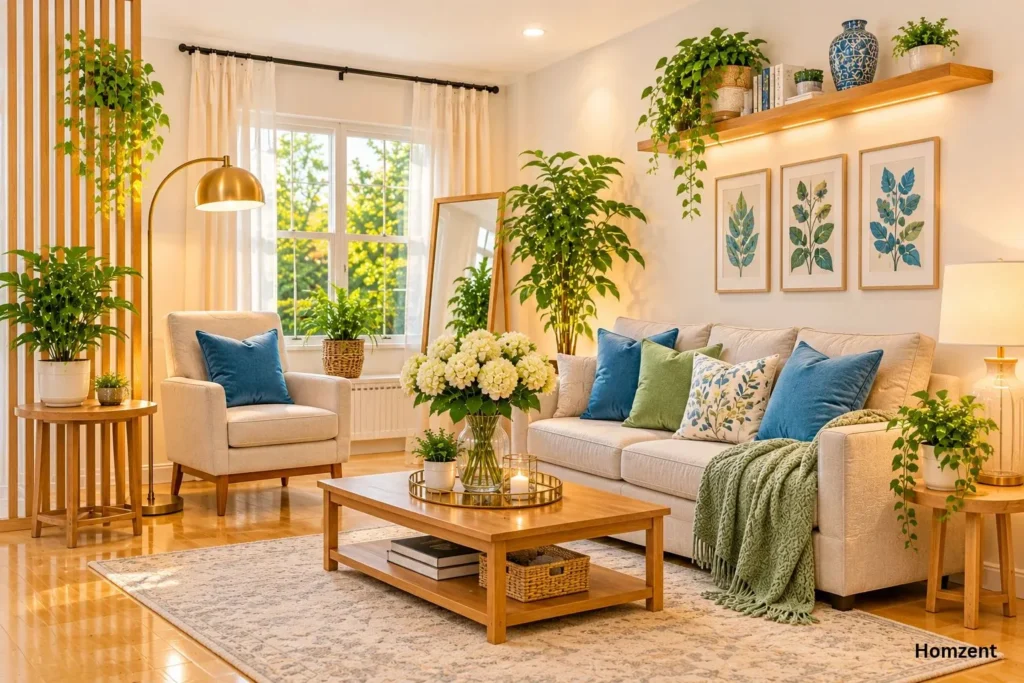
Keep art and texture soft in tone. A paneled screen in a pale finish divides space without feeling closed off, and mirrors facing a window trick the mind into seeing extra depth.
Do Mirrors Really Make a Small Living Room Look Bigger?
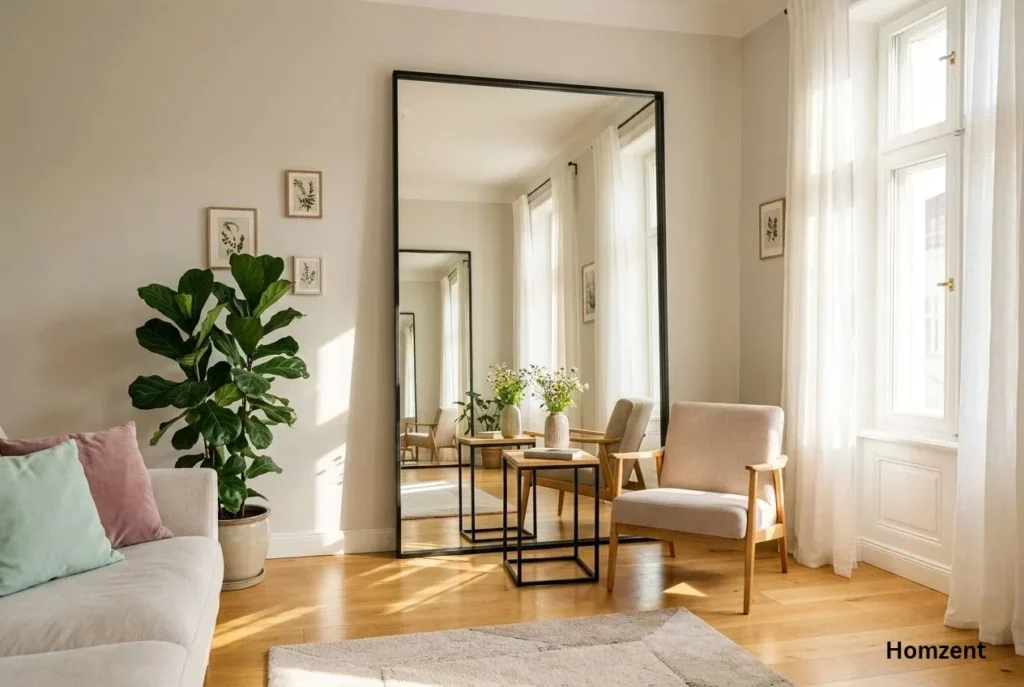
Yes, a mirror makes a small living room look bigger because it repeats light and the view, giving the eye a second room to read, and it works best facing a window or a lamp.
Among all the decoration ideas for tight rooms, a big mirror is one of the most effective. Hung across from sheer window treatments, a mirror doubles the daylight. Facing wall sconces or chandeliers, it doubles the evening glow. Treat it as a statement piece.
A mirror amplifies the mix of lights you already have. General lighting from ceiling lamps spreads uniform light, while task lighting beside a seat stays local. A mirror placed near that seat carries the light further.
The color palette decides what the mirror shows back. Pale neutrals and soft pastels look lighter in reflection. Carrying the wall color up onto the ceiling, or going one step paler there, helps heighten the walls.
Keep whatever stands in front of the glass low and see-through. A leggy armchair or an open-framed side table on slim legs keeps the reflected floor visible. Where a bare wall can’t hold a mirror, stack wall-mounted shelves floor to ceiling or hang a pegboard with hooks, so the eye still moves upward.
Where Should You Start When Decorating a Small Living Room?
Start decorating a small living room by deciding what the room must do, then fixing the furniture plan, and only then shopping for decor.
Many small rooms go wrong because the project starts with a cart full of accessories. Split the activities you want into must-haves and nice to haves, and keep the core list to 2 or 3. That is how you maximize a small room instead of overloading it.
This order keeps the work on track:
Define the purpose. Match the room to your lifestyle. A dream hangout for game nights needs a different plan than a quiet library.
Lock the plan. Work layout first, style second. Note the length and width in centimeters, carry those measurements while shopping, and you’ll avoid daily bumping into corners.
Choose flexible pieces. Poufs and stools serve as a footrest or a seat. Good upholstery over high-resiliency foam holds its shape, and handcrafted pieces with custom sizing and heirloom quality can fit odd walls better than mass-produced stock.
Plan movable zones. Dividing the room with a drape you can pull back lets you reunite the space in seconds.
Style last. Use the zigzag rule: place similar objects, such as two matching vases or items in the same color, on different shelves in a diagonal line (top left, middle right, bottom left), so the eye travels across the whole unit. Baskets and decorative boxes can hold the leftovers.
Daily habits count too. A floor mat in the seating area to catch outdoor grit is a common request, but a pair of slippers by the outside door often solves the same problem with less clutter.
If the room still feels off after the third reshuffle, a second set of eyes helps. An online design consult offers an outside perspective without any construction.