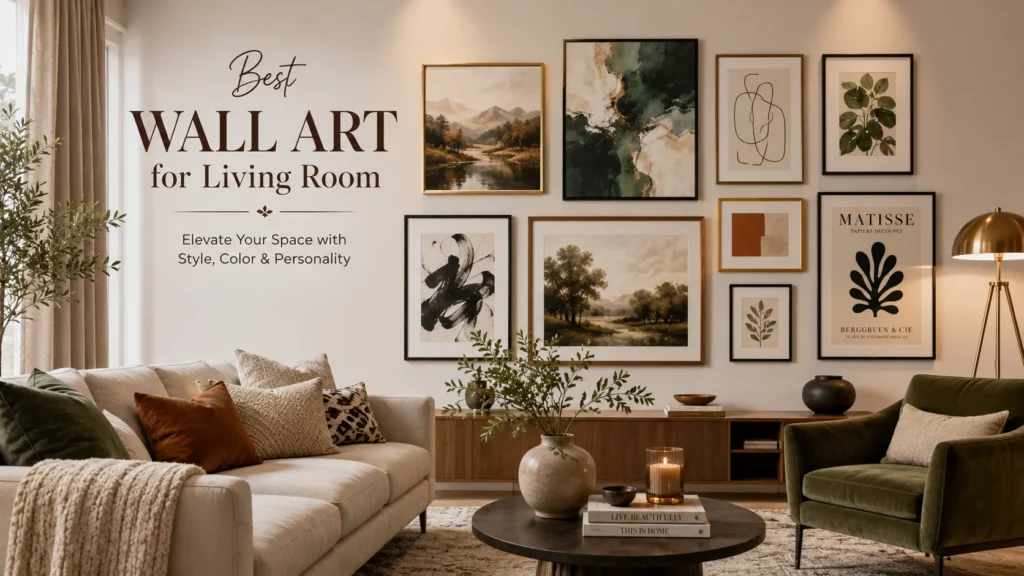
The right wall art has the power to transform an ordinary living room into a sophisticated, inviting, and visually stunning space. In this comprehensive guide to the Best Wall Art for Living Room 2026, we’ve carefully selected the latest trends, timeless designs, and premium décor ideas to help you create a living room that reflects your personality and style.
Whether you’re searching for modern canvas prints, elegant framed artwork, abstract masterpieces, minimalist designs, oversized statement pieces, or budget-friendly wall décor, this guide covers the best options for every home, interior style, and price range.
- The best wall art for living rooms in 2026 is large-scale, warm-neutral, and textured rather than flat or purely decorative (Urban Road, 2026).
- Pantone’s 2026 Color of the Year, Cloud Dancer, a soft balanced white, is driving demand for neutral and off-white art palettes (Pantone Color Institute, 2026).
- One oversized statement piece above the sofa is replacing multi-frame gallery walls as the dominant living room layout trend (YMI Painting, 2026).
- Art above a sofa should span roughly two-thirds to three-quarters of the sofa’s width and hang 6 to 10 inches above the backrest (Bruzzen, 2026).
- Best overall: large-scale abstract canvas. Best budget option: minimalist line art prints. Best for small rooms: framed botanical prints.
What to Look for in Living Room Wall Art
Four factors decide whether a piece works in a living room: scale, color, texture, and placement. Get these right and almost any style looks intentional.
| Criterion | Why It Matters |
|---|---|
| Scale | Undersized art reads as an afterthought. Most living rooms need one large piece, not several small ones. |
| Color | Warm neutrals and soft whites match 2026’s dominant palette and pair with more furniture than saturated colors. |
| Texture | Raised, textured surfaces catch light differently through the day and add depth that flat prints cannot. |
| Placement | Correct height and width above furniture is what separates a styled wall from a cluttered one. |
Large-Scale Abstract Canvas — Best Overall
A single oversized abstract canvas is the leading choice for 2026 living rooms. Designers are replacing multi-piece gallery walls with one large, textured painting that acts as the room’s focal point (Urban Road, 2026).
Key features:
- Works as a standalone focal point, no additional frames needed.
- Warm neutral colorways (cream, taupe, sand) match the broader shift away from cool gray palettes.
- Sizes typically start around 40×60 inches for a true statement effect.
Price range: $150–$800 depending on size and material.
Best for: Open-concept living rooms with one clear wall behind the sofa.
Textured Plaster and Mixed-Media Art — Best for Depth
Textured pieces built from plaster, resin, or layered paint are one of the strongest 2026 trends because they add visual depth that flat prints cannot (IrisLeeGallery, 2026).
Key features:
- Raised surfaces create shadow and highlight as natural light shifts through the day.
- Feels handmade rather than mass-produced, which buyers increasingly prefer.
- Pairs well with linen, boucle, and other tactile furniture fabrics.
Price range: $200–$1,200.
Best for: Living rooms already leaning into natural materials like wood, linen, and stone.
Warm Neutral and Cloud Dancer-Inspired Prints — Best for 2026 Color Trend
Pantone named Cloud Dancer, a balanced, soft white, its 2026 Color of the Year, describing it as a calming counterpoint to a noisy world (Pantone Color Institute, 2026). Wall art in this tone works in almost any living room palette.
Key features:
- Near-neutral base that will not clash with existing furniture colors.
- Reads as calm and uncluttered rather than stark or cold.
- Easy to update seasonally with a few smaller accent pieces around it.
Price range: $60–$500.
Best for: Renters or anyone who wants art that will outlast a furniture change.
Biophilic and Nature-Inspired Art — Best for Calm Spaces
Biophilic art uses organic shapes, natural materials, and earthy palettes to bring a nature-inspired feel indoors. It remains one of the strongest interior design movements heading into 2026 because it supports a calmer, more grounded mood (The Moss Shop, 2026).
Key features:
- Organic, non-geometric shapes such as waves, wood grain, and leaf forms.
- Often made with natural materials like preserved moss, wood, or stone dust.
- Pairs naturally with plants and wood furniture already in the room.
Price range: $100–$700.
Best for: Japandi, organic modern, or biophilic-styled living rooms.
Curated Gallery Wall — Best for Personality
A gallery wall groups vintage posters, prints, and framed pieces of different sizes into one arrangement. It works because the mix of scale, color, and framing keeps the wall feeling collected rather than store-bought (The Coolist, 2026).
Key features:
- Combines pieces collected over time instead of one matching set.
- Keep spacing between frames consistent, 2 to 4 inches apart, for a balanced look.
- The full arrangement should still respect the two-thirds sofa-width rule.
Price range: Varies widely, $10–$100 per individual frame.
Best for: Anyone building a collection over time rather than buying one large piece at once.
Minimalist Line Art — Best Budget Option
Line art uses single continuous strokes to suggest a figure, face, or shape. It remains popular because it is inexpensive, easy to frame, and fits almost any color scheme without competing with furniture.
Key features:
- Low cost per piece, making multi-print sets affordable.
- Works in small apartments where a large canvas would overwhelm the room.
- Easy to print at home or order from most print-on-demand services.
Price range: $15–$80.
Best for: First apartments, rentals, and tight budgets.
Metallic-Accent Art — Best for Added Glow
Pieces with gold, bronze, or silver leaf accents catch and reflect ambient light, which is why designers describe metallic finishes as an instant way to add warmth and elegance to a wall (Ridyart, 2026).
Key features:
- Reflective detailing changes appearance under different lighting.
- Works best as a smaller accent rather than the room’s only piece.
- Pairs well with brass or gold hardware already in the room.
Price range: $80–$400.
Best for: Living rooms that already use brass, gold, or warm metal fixtures.
Acoustic and Textile Wall Art — Best for Sound and Style
Acoustic wall art uses felt, fabric, or foam-backed panels to reduce echo while still functioning as decor. It is gaining traction in open-plan and media-heavy living rooms where hard surfaces make rooms feel loud (IrisLeeGallery, 2026).
Key features:
- Reduces echo and background noise, useful behind TVs or in open floor plans.
- Soft, tactile surface adds texture similar to plaster art.
- Portable and moves easily if you relocate.
Price range: $120–$600.
Best for: Open-concept living rooms with hard flooring and high ceilings.
Framed Botanical or Vintage Prints — Best for Small Spaces
A single framed botanical or vintage print anchors a small wall without overwhelming it. Simple botanical artwork works well alongside soft lighting and a plant nearby, without needing a large or busy arrangement.
Key features:
- Compact scale suits small living rooms, hallways, and apartments.
- Classic subject matter that rarely feels dated.
- Pairs well with wood or bamboo frames for a natural look.
Price range: $30–$150.
Best for: Studio apartments and rooms with limited wall space.
Oversized Photography Prints — Best for Modern Lofts
A single oversized black-and-white or muted-color photograph gives loft-style and industrial living rooms a clean focal point without the softness of a painting.
Key features:
- Works especially well with concrete, brick, or exposed-beam walls.
- Available in large formats up to 60 inches or wider.
- Simple to match to a monochrome or black-and-white furniture palette.
Price range: $100–$600.
Best for: Loft, industrial, or modern minimalist living rooms.
Comparison Table: Wall Art Styles at a Glance
| Style | Best For | Price Range | Key Trait |
|---|---|---|---|
| Large-scale abstract canvas | Overall statement wall | $150–$800 | Single focal point |
| Textured plaster/mixed-media | Tactile, layered look | $200–$1,200 | Raised surface, catches light |
| Warm neutral / Cloud Dancer | Flexible, long-term color | $60–$500 | Matches 2026 color trend |
| Biophilic / nature-inspired | Calm, organic spaces | $100–$700 | Organic shapes, natural materials |
| Curated gallery wall | Personality and collections | $10–$100/frame | Multiple mixed pieces |
| Minimalist line art | Budget shoppers | $15–$80 | Low cost, easy to frame |
| Metallic-accent art | Extra warmth and shine | $80–$400 | Reflective detailing |
| Acoustic/textile art | Noise reduction | $120–$600 | Functional and decorative |
| Framed botanical/vintage | Small walls | $30–$150 | Compact, classic subject |
| Oversized photography | Loft/industrial rooms | $100–$600 | Clean monochrome focal point |
How to Size and Hang Wall Art Above a Sofa
Measure your sofa’s width, then multiply by 0.66 and by 0.75 to get your target art width range. For a standard 84-inch sofa, that is roughly 56 to 63 inches wide (Bruzzen, 2026).
Hang the piece so its bottom edge sits 6 to 10 inches above the sofa’s backrest, with the center of the art at about 57 to 60 inches from the floor. This keeps the art visually connected to the furniture instead of floating too high.
Frequently Asked Questions About Wall Art for Living Rooms in 2026
What is the best wall art trend for living rooms in 2026?
Large-scale, textured, warm-neutral abstract art is the dominant trend, replacing multi-frame gallery walls with one oversized statement piece (Urban Road, 2026).
What color wall art matches 2026 interior trends?
Soft, balanced whites and warm neutrals match the trend closely, echoing Pantone’s 2026 Color of the Year, Cloud Dancer (Pantone Color Institute, 2026).
How big should wall art be above a sofa?
Art should span roughly two-thirds to three-quarters of the sofa’s width and hang 6 to 10 inches above the backrest, with its center at 57 to 60 inches from the floor (Bruzzen, 2026).
Are gallery walls still in style in 2026?
Yes, but they are less common as the default choice. Many living rooms now use one large piece instead, though gallery walls remain popular for collected or personal displays (The Coolist, 2026).
Is textured wall art worth the extra cost?
Textured and plaster-style pieces cost more than flat prints but add depth that changes with the room’s lighting, which is a major reason they are trending in 2026 (IrisLeeGallery, 2026).
Can I mix wall art styles in one living room?
Yes. A large neutral abstract piece above the sofa can be paired with a smaller framed print or metallic accent elsewhere in the room, as long as one piece remains the clear focal point.
Final Verdict
The best wall art for your living room does more than fill an empty wall—it tells your story, enhances your décor, and creates a space that feels both inviting and memorable. Whether you prefer oversized statement pieces, timeless gallery walls, modern abstract canvases, textured artwork, or nature-inspired prints, the right selection can instantly transform your home without requiring a complete redesign.
As you decorate your living room in 2026, focus on choosing artwork that complements your colour palette, furniture, lighting, and personal style. Mixing different sizes, frames, and textures while maintaining visual balance will help you create a space that feels professionally designed yet uniquely yours. Remember, great wall art isn’t just decoration—it’s an investment in the atmosphere and personality of your home.
Transform Your Home with Homzent
Looking for more expert decorating inspiration? Homzent is your trusted destination for modern home décor ideas, room styling guides, seasonal decorating trends, and practical design tips that make every space feel beautiful and functional.
Explore more decorating inspiration at Homzent and discover fresh ideas to create a living room you’ll love for years to come.