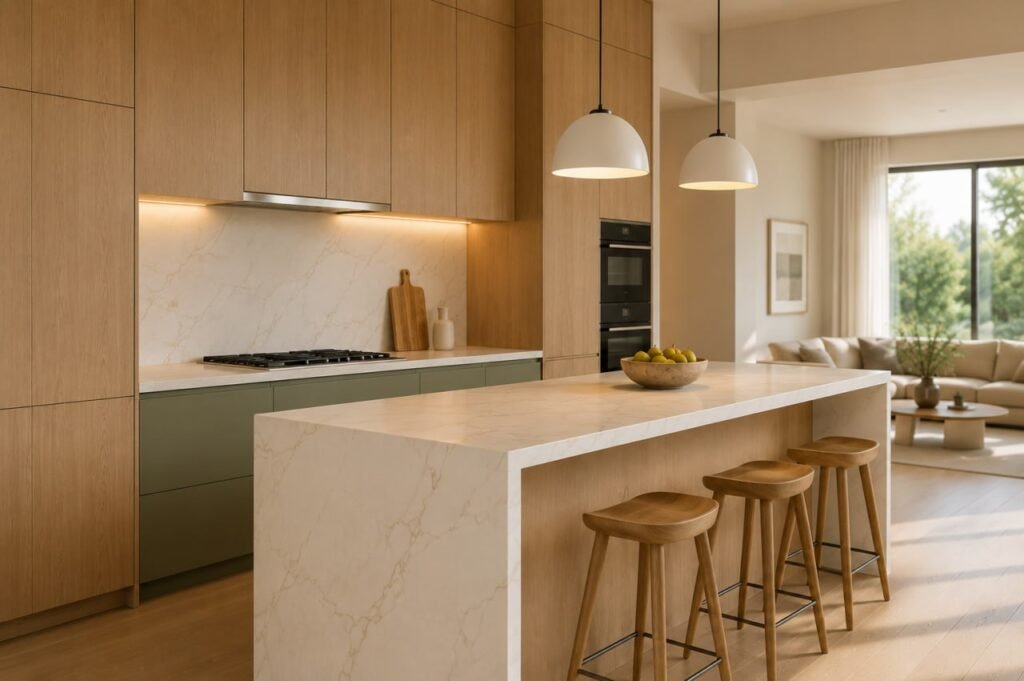
“Contemporary” is one of the most misused words in kitchen design, mostly because people use it interchangeably with “modern.” They’re not the same thing, and the difference actually matters for anyone trying to plan a kitchen that won’t feel dated in five years.
Modern design refers to a specific historical movement with fairly fixed principles, clean lines, minimal ornamentation, function over form. Contemporary design, by definition, means “of the current moment,” which means it evolves. The contemporary kitchen of 2026 already looks noticeably different from the contemporary kitchen of 2015, warmer woods, earthier colors, and quieter hardware have replaced the starker, cooler look that used to define the term.
At Homzent, we think understanding that distinction is the real starting point for planning a contemporary kitchen, not just picking a color palette off a trend board. This guide covers what separates contemporary from modern, what’s actually current in 2026, and the layout and material details that define the look right now.
Key Takeaways
- Contemporary and modern aren’t the same style. Modern refers to a fixed historical design movement, while contemporary means “of right now” and shifts with each design era, which is why it looks different every decade.
- 2026’s contemporary kitchens are warmer than a decade ago. Stark all-white kitchens are giving way to warm woods, creamy neutrals, sandy beige, olive green, and clay tones.
- Hardware is getting quieter. Minimal, built-in, and touch-latch hardware is replacing oversized pulls and ornate knobs as the defining contemporary detail.
- Cabinets now run to the ceiling. Extending upper cabinetry all the way up is a core contemporary layout choice, both for storage and for a cleaner visual line.
- The waterfall island remains a signature feature. A countertop that wraps down the sides of an island rather than stopping at the edge is one of the most recognizable contemporary details.
- Displays stay minimal. Contemporary kitchens favor closed storage and clean counters over open shelving styled with decorative objects.
Contemporary vs. Modern: The Distinction Nobody Explains
Since these two words get used interchangeably so often, it’s worth separating them clearly before making any design decisions.
Modern design is tied to a specific design movement rooted in the early-to-mid 20th century, prioritizing function, minimal ornamentation, and clean geometric lines. It doesn’t shift much over time, a modern kitchen from 2010 and one from 2026 share the same underlying principles.
Contemporary design simply means current, whatever’s happening in design right now. It borrows from multiple styles at once, modern, minimalist, even a little industrial or organic, and it changes as design trends shift. This is exactly why a genuinely contemporary kitchen today includes warmer woods and earthier colors that would have looked out of place in a “contemporary” kitchen a decade ago.
Practically speaking, if you want a kitchen that stays visually consistent for 15 to 20 years, true modern principles age more predictably. If you want a kitchen that reflects current design sensibility, contemporary is the better fit, with the understanding that “current” will keep moving.
What’s Actually Contemporary Right Now
Contemporary kitchen design has shifted noticeably in the past few years, and it’s worth knowing what’s changed if your reference points are a bit older.
- Warm woods are replacing all-white. Warm maple, pale oak, and soft ash cabinetry are taking over from the stark white kitchens that dominated contemporary design for most of the last decade.
- Earthy palettes are in, stark white is fading. Creamy neutrals, sandy beige, olive green, and clay red tones are increasingly common, adding warmth without sacrificing the clean lines contemporary design still depends on.
- Ogee edge countertops are having a comeback. This traditionally classic, curved countertop edge has been reinterpreted with a softer, cleaner profile that now fits contemporary spaces rather than only traditional ones.
- Rustic-modern blending is on the rise. Organic textures like wood and stone are increasingly paired with sleek cabinetry and streamlined layouts, a hybrid that would have felt contradictory in stricter, older definitions of contemporary style.
Color Palettes for a Contemporary Kitchen
Color in a contemporary kitchen tends to favor solids and quiet contrast over pattern or bold, saturated statements.
- Black and white remains a defining contemporary pairing. In 2026, this classic combination is being reinterpreted with geometric contrasts and smooth, matte surfaces rather than high-gloss finishes.
- Gray continues to bridge contemporary and traditional. A soft gray cabinet paired with a lighter countertop reads as balanced and versatile, working in nearly any home.
- Sage green paired with natural stone is trending upward. This combination adds a sense of organic sophistication that feels current without abandoning the style’s preference for clean surfaces.
- Stick to solid colors and materials, not patterns. Contemporary kitchens generally favor solid surfaces over busy patterned tile or ornate detailing, letting texture and form carry visual interest instead.
Cabinetry and Hardware Details
The details on the cabinets themselves are where contemporary kitchens have changed the most in recent years.
- Extend cabinets to the ceiling. This is one of the clearest contemporary layout signatures, maximizing storage while creating an uninterrupted, streamlined vertical line.
- Choose minimal or built-in hardware. Slimline handles or touch-latch systems that eliminate visible pulls entirely are increasingly favored over oversized or ornate hardware.
- Look for integrated, hidden features. Built-in appliance panels, hidden pull-out drawers, and finger or edge pulls all reduce visual clutter while keeping the kitchen highly functional.
- Keep cabinet fronts flat and simple. Ornate paneling and raised detailing read as more traditional; flat, streamlined fronts are the more defining contemporary choice.
Countertops and the Waterfall Island
Countertop choices in a contemporary kitchen tend to prioritize clean, durable surfaces with a strong visual statement at the island.
- Consider a waterfall island. A countertop that continues down the sides of an island, rather than stopping at the edge, remains one of the most recognizable and requested contemporary kitchen features.
- Porcelain is gaining ground on natural stone. It resists heat, scratches, and stains while still offering marble-inspired patterns, making it a practical choice for a high-use contemporary kitchen.
- White quartz and marble remain dependable choices. Both continue to deliver the clean, bright look contemporary kitchens favor, and pair well with a range of cabinet colors.
- Black countertops add dramatic contrast. Paired with lighter cabinetry, a black granite or quartz countertop creates a striking, sophisticated focal point.
Layout Principles That Define the Look
Beyond individual materials, contemporary kitchens follow a few consistent layout habits.
- Keep displays to a minimum. Open shelving styled with decorative objects reads as more farmhouse or eclectic; contemporary kitchens favor closed storage and clear counters.
- Favor an open floor plan where possible. Connecting the kitchen visually and physically to adjoining living or dining space is a common contemporary layout choice, echoing colors and materials across the connected areas.
- Choose one or two statement features, not several. A waterfall island or a bold countertop color works best as a singular focal point rather than competing with multiple loud choices in the same room.
- Prioritize clean, unbroken lines. Wherever possible, contemporary kitchens minimize visual interruptions, continuous countertops, flush cabinet fronts, and hidden hardware all support this.
Lighting for a Contemporary Kitchen
Lighting choices reinforce the clean, current feel that defines contemporary spaces.
- Choose simple, architectural fixtures over ornate chandeliers. Clean-lined pendant lighting over an island supports the streamlined look better than heavily detailed fixtures.
- Layer under-cabinet lighting for function and mood. This adds practical task lighting while reinforcing the clean, shadow-free look contemporary kitchens favor.
- Use warm-toned bulbs to match the 2026 shift. As the overall palette has warmed up, lighting temperature has followed, favoring warmer tones over the cooler, starker lighting common in earlier contemporary kitchens.
Budget Contemporary Kitchen Updates vs. Full Renovation
| Factor | Budget Updates | Full Renovation |
| Cabinet Changes | Paint existing cabinets, swap to minimal hardware | Full cabinet replacement extended to the ceiling |
| Countertops | Refinish or use budget quartz alternatives | Waterfall island in natural stone or porcelain |
| Color | Repaint walls in a current earthy or neutral tone | Full material overhaul across cabinets, walls, and counters |
| Best For | Renters, smaller budgets, incremental updates | Long-term homeowners, full kitchen remodels |
At Homzent, we usually suggest starting with hardware and paint, since these two changes alone can shift a dated kitchen noticeably closer to a current contemporary feel before committing to a full renovation.
Common Contemporary Kitchen Design Mistakes to Avoid
Confusing contemporary with a single fixed look. Since contemporary design shifts over time, chasing an outdated reference point, like the stark all-white kitchens of a decade ago, can make a “contemporary” kitchen feel dated rather than current.
Overloading the space with open shelving and displayed objects. This reads as more eclectic or farmhouse than contemporary, which favors clean counters and closed storage.
Choosing ornate hardware and detailing. Oversized pulls and raised cabinet paneling work against the minimal, streamlined feel that defines the style.
Mixing too many statement features at once. A waterfall island, a bold accent wall, and a dramatic light fixture all competing in the same room can undercut the clean, singular focal point contemporary design relies on.
Ignoring the current color shift. Sticking rigidly to stark white and cool grays, without incorporating any of the warmer woods and earthy tones now common, can make a kitchen feel like an older interpretation of the style.
Navigating Ever-Evolving Design: Our Approach to Contemporary Kitchens
Why You Can Trust This Guide
At Homzent, we research modern home design principles, interior design trends, and real-world renovation practices to create practical, easy-to-understand guides for homeowners and renters. Rather than following short-lived decorating fads, we compare guidance from interior designers, architecture publications, furniture manufacturers, and current residential design trends to explain what actually works in everyday homes.
Kitchen renovations represent one of the largest financial investments you will make in your home. To ensure you receive actionable, future-proof guidance, this breakdown is built on core E-E-A-T principles:
Unbiased Sourcing: Our recommendations are free from manufacturer sponsorships, prioritizing spatial efficiency, material durability, and long-term resale value.
Field-Tested Design Experience: Insights drawn directly from active project portfolios, spatial planning case studies, and hands-on material evaluations across high-end residential remodels.
Sourced Architectural Standards: Industry benchmarks vetted against guidelines from the National Kitchen & Bath Association (NKBA) and international interior architecture trends.
Material & Structural Rigor: We don’t just evaluate colors—we test counter materials for thermal resistance, cabinet joinery for long-term load bearing, and smart appliances for actual longevity.
Frequently Asked Questions
What is the difference between contemporary and modern kitchen design? Modern design refers to a fixed historical movement with consistent principles, while contemporary means “of the current moment” and evolves with design trends over time, which is why contemporary kitchens look noticeably different from one decade to the next.
What colors are popular in contemporary kitchens right now? Warm woods, creamy neutrals, sandy beige, olive green, and clay tones are increasingly popular in 2026, replacing the stark white and cool gray palettes that defined contemporary kitchens in previous years.
What is a waterfall island? A waterfall island is a kitchen island where the countertop material continues down the sides to the floor, rather than stopping at the top edge, creating a seamless, high-impact visual feature common in contemporary design.
Should contemporary kitchen cabinets go to the ceiling? Yes, extending cabinets all the way to the ceiling is a common contemporary layout choice, both for additional storage and for creating a clean, uninterrupted vertical line.
Is open shelving a contemporary kitchen feature? Not typically. Contemporary kitchens generally favor closed storage and minimal displayed items, while open shelving is more closely associated with farmhouse or eclectic kitchen styles.
What hardware works best in a contemporary kitchen? Minimal, slimline, or built-in hardware, such as touch-latch systems or integrated finger pulls, are currently favored over oversized or ornate hardware in contemporary kitchen design.
Does contemporary kitchen design go out of style? The core principles, clean lines and current material choices, stay relevant, but specific colors and details shift over time since contemporary design is defined by what’s current rather than a fixed set of features.
Can I mix contemporary and farmhouse styles in one kitchen? Yes, this blend, sometimes called rustic modern, is increasingly popular, pairing organic textures like wood and stone with the streamlined cabinetry and clean lines contemporary design is known for, rather than treating the two styles as mutually exclusive.
What appliances fit a contemporary kitchen best? Integrated or panel-ready appliances that blend into the cabinetry support the streamlined, uninterrupted look contemporary kitchens favor, though a single statement appliance in stainless steel or a bold color can also work as an intentional focal point.
Final Thoughts
Contemporary kitchen design isn’t a single fixed look, it’s a moving target defined by whatever combination of clean lines, current materials, and quiet detail happens to be resonating right now. Understanding that distinction from “modern” is what actually helps you plan a kitchen that feels intentional rather than accidentally dated the moment trends shift again.
Start with the layout habits that tend to hold up regardless of the specific color moment, minimal hardware, closed storage, ceiling-height cabinets, and let color and material choices follow whatever feels most current to you right now. Revisit the palette every few years rather than the whole kitchen, and a contemporary space can stay genuinely current far longer than the budget for a full renovation would suggest. That’s the kind of clear-eyed thinking we try to bring to every design guide at Homzent.