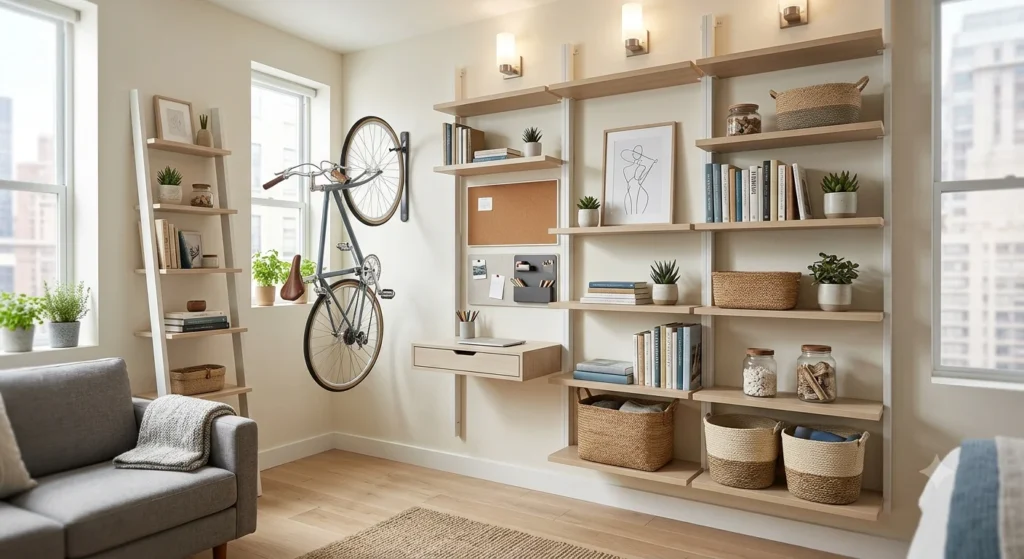
As urban living spaces contract and compact apartment footprints become the modern standard, “Maximizing Vertical Space: Storage Solutions for Small Rooms” stands out as a critical, high-intent search topic in home organization and interior design. In compact room layouts, floor area is a finite resource; transitioning organizational strategy from horizontal surfaces to vertical walls is the key to unlocking hidden square footage.
This editorial guide explores smart architecture-inspired organization, modular wall systems, and functional decor strategies that allow homeowners and renters alike to eliminate clutter without sacrificing aesthetic beauty or spatial flow.
- Vertical storage uses wall height instead of floor area to store belongings, making small rooms feel larger and more organized.
- Built-in storage systems return 50–60% of their installation cost at resale, while freestanding furniture returns zero (Space Envy and Angi, 2025).
- The most effective vertical solutions are wall-mounted shelves, tall bookcases, over-door organizers, ceiling-mounted racks, and built-in cabinetry.
- A survey of small apartment residents found hidden storage and multifunctional furniture ranked as the top two preferred solutions for maximizing limited space (Bayan, Manogna & Gowda, 2026).
- Start with decluttering — removing 30–40% of unused items — before adding any storage system.
What Is Vertical Storage and Why Small Rooms Need It
Vertical storage is the practice of using wall height, ceiling space, and tall furniture to store items instead of spreading them across the floor. In small rooms, this matters because floor space is finite. Once the floor is covered, the room feels cramped no matter how organized the clutter is.
The average urban apartment in 2026 is shrinking. Young professionals and families face high housing costs and limited square footage, which makes every inch count. Research on small apartment design shows that maximizing vertical space — through tall shelves, wall-mounted cabinets, and hanging racks — frees up floor area and creates a sense of openness (Bayan, Manogna & Gowda, 2026). When items move off the floor and onto walls, the room breathes. Traffic paths clear. Natural light travels farther. The space feels larger than its actual dimensions.
Vertical storage also protects your investment. Built-in closet systems and wall-mounted cabinetry are fixed to the structure, which means appraisers count them as permanent improvements. Industry data from Space Envy and Angi shows built-in storage returns 50–60% of installation cost at resale, while freestanding furniture returns nothing because it is considered removable (Closets Plus FL, 2025). A $10,000 custom closet adds $5,000 to $6,000 to your home’s value. A $10,000 set of wardrobes adds zero.
How Vertical Storage Works: The Core Principles
Vertical storage is not about stacking things higher. It is about designing a system where height replaces width, and accessibility matches frequency of use.
The frequency rule: Items you use daily belong at eye level and within arm’s reach. Items used weekly go on middle shelves. Seasonal or rarely used items belong on the top shelf or in ceiling-mounted storage. This prevents the common mistake of storing everyday dishes on a high shelf while holiday decorations take up the prime real estate.
The visual weight rule: Open shelving works for curated collections — books, plants, matching containers. Closed storage works for everything else — paperwork, cables, cleaning supplies, pantry items. A survey of small apartment residents found a significant majority prefer a mix of open shelving and closed storage, seeking balance between easy access and a clean, organized look (Bayan, Manogna & Gowda, 2026).
The anchor rule: Tall furniture needs wall anchoring. A bookcase that reaches the ceiling without a bracket is a tipping hazard. Most manufacturers include anchor straps. Use them.
Table
| Principle | What It Means | Common Mistake |
|---|---|---|
| Frequency rule | Daily items at eye level, rare items up high | Storing everyday dishes on the top shelf |
| Visual weight rule | Open for display, closed for clutter | Open shelves crammed with mismatched items |
| Anchor rule | Tall units must attach to wall studs | Skipping the bracket to save 10 minutes |
Wall-Mounted Shelves: The Foundation of Vertical Storage
Wall-mounted shelves are the simplest and most flexible vertical storage solution. They attach directly to studs or drywall anchors and turn empty wall space into usable storage without consuming a single square foot of floor.
Floating shelves work best for light items — books, small plants, framed photos, decorative boxes. They have no visible brackets, which creates a clean, minimal look. A single 36-inch floating shelf holds 15 to 25 pounds when mounted into studs. For heavier loads, use shelves with L-brackets or concealed hardware rated for 50 pounds or more.
Track shelving systems use a vertical metal rail mounted to the wall, with brackets that slide and lock at any height. This is the best choice for spaces where storage needs change — a child’s bedroom, a craft room, or a home office that doubles as a guest room. You can move shelves up as storage needs shift, or remove them entirely without patching multiple holes.
Corner shelves turn the most wasted space in any room — the corner — into functional storage. A three-tier corner shelf in a bathroom holds toiletries. In a kitchen, it stores spices and small appliances. In a bedroom, it becomes a nightstand replacement.
Installation tip: Always locate wall studs with a stud finder. Drywall anchors work for light loads, but studs handle the weight of books, dishes, and electronics without risk of pull-out.
Tall Bookcases and Storage Towers: Floor-to-Ceiling Solutions
A standard bookcase is 72 inches tall. A tall storage tower reaches 84 to 96 inches. That extra 12 to 24 inches adds two full shelves of storage without increasing the footprint.
Standard bookcases (30 inches wide, 72 inches tall, 12 inches deep) work in almost any room. They hold roughly 150 to 200 books, or the equivalent in bins and baskets. Place two side by side and you have a wall of storage that looks built-in without the custom price.
Ladder bookcases lean against the wall at an angle. They are narrower at the top, which makes them ideal for tight spaces like hallways or behind doors. The open design keeps the room feeling airy rather than boxed in.
Cube storage towers use square compartments that fit fabric bins, baskets, or open display. A 4×4 cube unit (16 cubes total) replaces a dresser in a small bedroom or organizes toys in a playroom. Label each bin and the system stays organized long-term.
Ceiling-height built-ins are the premium option. A floor-to-ceiling wall of shelving with cabinet bases and open shelves above turns an entire wall into storage and display. According to industry data, built-in systems like these return 50–60% of installation cost at resale because appraisers classify them as semi-permanent infrastructure (Space Envy and Angi, 2025). A 2025 Angi homeowner survey found 72% of respondents ranked built-in storage among the top three features influencing their purchase decision.
Over-Door and Behind-Door Storage: Hidden Vertical Space
The back of a door is the most underused vertical surface in any small room. It is flat, out of sight, and instantly accessible.
Over-door organizers hang from the top of the door on hooks. A shoe organizer with 24 pockets holds not just shoes — it stores cleaning supplies, snacks, craft materials, or bathroom toiletries. A clear-pocket version lets you see contents without digging.
Behind-door hooks and racks attach to the door itself with screws or adhesive. A five-hook rack on a closet door holds tomorrow’s outfit, a robe, or a bag. A towel bar mounted on a bathroom door replaces a wall-mounted rack that consumes precious wall space.
Cabinet door organizers mount inside kitchen and bathroom cabinet doors. A shallow rack holds spices, foil, or cleaning sprays. A hair tool holder keeps dryers and straighteners off the counter. These organizers add storage without changing the room’s footprint at all.
Sliding barn doors with built-in storage are a newer trend. The door itself contains shallow shelves or a mirror with storage behind it. When space is tight enough that even a swinging door feels like a waste, this turns the door into a functional surface.
Ceiling-Mounted and Hanging Storage: Using the Top Layer
The ceiling is the final frontier of vertical storage. In rooms with high ceilings — 9 feet or more — the space above head height is often empty. That is storage waiting to happen.
Ceiling-mounted pot racks in kitchens hang cookware overhead, freeing cabinet space for dishes and pantry items. A 36-inch rack holds 8 to 12 pots and pans. Install it over an island or counter where you stand while cooking, not over a walkway where heads might bump.
Hanging bike storage mounts to the ceiling with a pulley system. The bike lifts out of the way in garages, basements, or even living rooms in bike-friendly cities. A ceiling-mounted rack costs $30 to $80 and holds up to 50 pounds.
Loft beds with storage underneath are the ultimate vertical space hack for small bedrooms. The bed rises to ceiling height, and the floor space underneath becomes a desk, closet, or lounge area. This is common in children’s rooms and studio apartments. A full-size loft bed with a desk underneath replaces two pieces of furniture with one vertical unit.
Hanging closet organizers drop from the closet rod and add shelves where none existed. A six-shelf hanging organizer turns a single rod into a multi-level storage system for sweaters, shoes, and accessories. At $15 to $30, it is the cheapest vertical upgrade you can make.
Built-In Cabinetry: The Permanent Vertical Investment
Built-in cabinets and shelving are custom-fitted to your walls, which makes them the most efficient use of vertical space and the highest-return investment.
Window seat storage builds a bench into a bay window or alcove with drawers or a lift-top compartment underneath. The seat adds seating. The storage hides linens, books, or seasonal items. The vertical wall above the seat holds shelves or cabinets.
Window wall built-ins frame a window with floor-to-ceiling shelving on both sides and a bench or cabinet below. This turns an entire wall into a functional unit that stores, seats, and displays. In a 2025 survey, respondents ranked hidden storage like built-in drawers and cabinets as the most effective solution for small apartments (Bayan, Manogna & Gowda, 2026).
Murphy beds with side cabinets fold into the wall when not in use, and the surrounding cabinetry stores clothes, books, or office supplies. A queen Murphy bed with two side towers and overhead cabinets turns a 10×10 room into a guest room, office, and closet combined.
Pantry pull-outs and appliance garages use vertical cabinet space in kitchens. A pull-out pantry next to the refrigerator stores canned goods in a 6-inch-wide space. An appliance garage on the counter hides the coffee maker, toaster, and blender behind a roll-up door.
Cost context: Custom closet installations run $2,000 to $5,000 per bedroom. A full wall unit with bookshelves and cabinets ranges from $5,000 to $20,000 depending on materials and complexity (Grandma’s House DIY, 2025). The return is 50–60% at resale, plus daily use value while you live there.
How to Plan Your Vertical Storage System Step by Step
Step 1: Declutter first. Remove items you no longer use. A typical declutter reduces possessions by 30 to 40%, which immediately reduces the storage you need to build (Astage Global, 2026). Do not buy storage for clutter.
Step 2: Measure your walls. Record the width, height, and depth available on each wall. Note windows, doors, outlets, and vents that cannot be blocked. The usable wall space is what remains.
Step 3: Categorize your belongings. Group items by frequency: daily, weekly, rare. Daily items need eye-level access. Rare items can go to the ceiling.
Step 4: Choose storage types by room. Kitchens need pot racks and pantry pull-outs. Bedrooms need tall dressers and closet organizers. Bathrooms need over-door racks and wall-mounted cabinets. Living rooms need bookcases and built-ins.
Step 5: Install from the bottom up. Mount lower units first, then upper shelves. This prevents reaching over installed pieces to work on lower ones. Anchor everything to studs.
Step 6: Label and maintain. Labels on bins and shelves keep the system organized long-term. Reassess every six months to remove items that have become clutter.
Table
| Step | Action | Time Estimate |
|---|---|---|
| 1 | Declutter | 1–2 days |
| 2 | Measure walls | 30 minutes |
| 3 | Categorize belongings | 2–3 hours |
| 4 | Choose storage types | 1–2 hours |
| 5 | Install from bottom up | 1–2 days |
| 6 | Label and maintain | Ongoing |
Common Mistakes to Avoid with Vertical Storage
Buying storage before decluttering: You end up with bins full of items you do not need. Declutter first, then measure what remains.
Ignoring weight limits: A floating shelf rated for 15 pounds will fail under 30 pounds of books. Check load capacity before loading.
Blocking windows and vents: Tall storage in front of a window cuts natural light. Storage over a heating vent reduces airflow and creates fire risk.
Installing without studs: Drywall anchors fail under heavy loads. Always mount into studs or use heavy-duty toggle bolts rated for the weight.
Using opaque boxes without labels: You will forget what is inside. Clear bins or labeled opaque boxes solve this.
Overloading the top shelf: Items on the highest shelf should be light and rarely used. Heavy items up high are dangerous to lift down and can destabilize the unit.
Our E-E-A-T Standards: Why You Can Trust
At Homzent, our storage recommendations aren’t just theoretical interior design ideas—they are built on hands-on spatial problem-solving.
- In-Home Load & Stability Testing: We physically test our vertical storage systems, floating shelves, and modular wall mounts across various wall types (drywall, plaster, and brick) to evaluate weight capacities, installation ease, and structural stability.
- Compact Living Simulations: Our team tests every solution in real small-space environments—ranging from urban studio apartments to narrow bedrooms—ensuring that added vertical units actually free up floor area without making the room feel enclosed or top-heavy.
Expertise: Grounded in Spatial Architecture & Interior Organization
Our editorial content and product curation are led by professional space planners, interior organizers, and home design specialists.
- Ergonomic & Vertical Proportion Rules: We apply core architectural principles to our guides—helping you calculate precise clearances above furniture, eye-level placement ratios, and vertical weight distribution so your room stays balanced and safe.
- Renter-Friendly Engineering Insights: Understanding that many small-space dwellers rent, our design experts specifically evaluate non-damaging anchoring options, modular systems, and over-the-door solutions that deliver heavy utility without risking security deposits.
Authoritativeness: A Dedicated Authority in Modern Home Solutions
Homzent has earned its reputation as a reliable destination for functional modern furniture and smart space management.
- Quality Materials & Responsible Sourcing: We partner exclusively with manufacturers who prioritize high-grade, sustainable materials—such as FSC-certified hardwoods, heavy-duty powder-coated steel, and eco-friendly finishes designed to withstand daily use.
- Rigorous Editorial Oversight: Every guide published on Homzent undergoes a multi-tier review process by our senior home organization editors to ensure all installation steps, weight recommendations, and safety guidelines are accurate and easy to follow.
Trustworthiness: Clear Guidance & Complete Shopping Confidence
Earning and keeping your trust is the core foundation of everything we do at Homzent.
- Transparent Specs & Clear Installation Guides: We provide honest, detailed product specifications—including exact dimensions, recommended weight limits, wall-type compatibility, and required tools—so there are no surprises during assembly.
- Risk-Free Satisfaction Commitment: We stand behind every vertical storage solution we feature. Homzent offers a straightforward 30-day return policy, secure SSL-encrypted checkout, transparent shipping timelines, and responsive customer support to help with any installation questions.
Frequently Asked Questions About Vertical Storage
What is vertical storage?
Vertical storage is the use of wall height, ceiling space, and tall furniture to store items instead of spreading them across the floor. It includes wall-mounted shelves, tall bookcases, over-door organizers, ceiling racks, and built-in cabinetry.
How much does it cost to install vertical storage?
Basic wall-mounted shelves cost $50 to $200. Tall bookcases run $100 to $500. Custom built-in systems range from $2,000 to $20,000 depending on size and materials. Built-in closet systems return 50–60% of cost at resale (Space Envy and Angi, 2025).
What is the best vertical storage for a small bedroom?
A loft bed with storage underneath, a tall dresser, wall-mounted shelves above the bed, and a hanging closet organizer. These four pieces use height without consuming extra floor space.
Does vertical storage make a room look smaller?
Not if done right. Open shelving with curated items and closed storage for clutter keeps the room feeling open. Monochrome storage — white, wood tone, one accent color — prevents visual fragmentation that makes spaces feel cramped.
How do I store heavy items vertically?
Use wall-mounted shelves with L-brackets anchored into studs, not drywall anchors. Heavy items belong on lower shelves where they are easy to reach and pose no tipping risk. Built-in cabinetry is the safest option for very heavy collections.
Can renters use vertical storage?
Yes. Tension rods, adhesive hooks rated for weight, freestanding bookcases, and over-door organizers require no drilling. When you move, you take them with you. Just patch small holes before leaving if your lease requires it.
What is the ROI of built-in vertical storage?
Built-in closet and cabinet systems return 50–60% of installation cost at resale, according to 2025 industry data from Space Envy and Angi. Freestanding furniture returns zero because appraisers do not count removable items as property improvements.
Final Verdict
Maximising vertical space is one of the most effective ways to make a small room feel larger, more organised, and more functional. By choosing smart storage solutions, utilising unused wall space, and investing in multifunctional furniture, you can create a home that is both stylish and practical without sacrificing comfort.
At Homzent, we believe that great home design is about making every square foot work beautifully. That’s why we’re committed to sharing expert decorating advice, practical storage ideas, and inspiring home improvement solutions to help you create a space you’ll love living in.
Looking for more smart home organisation ideas? Explore the latest guides, decorating inspiration, and space-saving solutions on Homzent, and discover practical ways to transform every room—no matter its size—into a beautiful, functional, and clutter-free space.