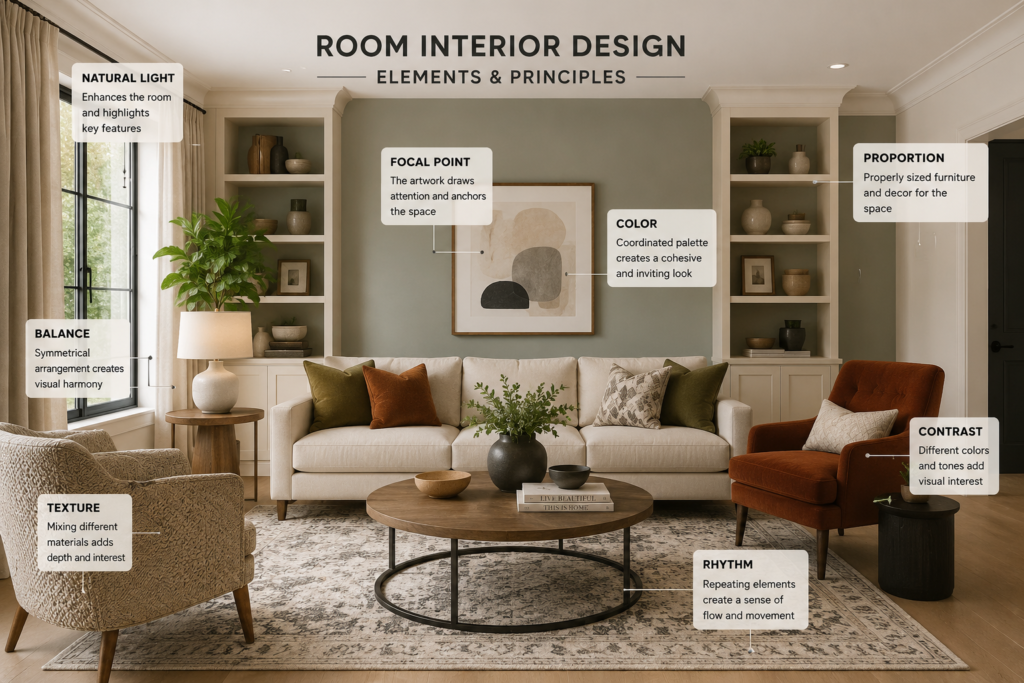
“Room interior design elements and principles”
Most people trying to learn room interior design start by scrolling Pinterest for hours, saving photos of rooms they like without ever figuring out why those rooms work. That’s not really their fault. Most interior design content skips straight to “ideas” without ever explaining the small number of rules those ideas are actually built on.
At Homzent, we think that’s the wrong place to start. Once you understand the handful of elements and principles every designed room shares, you stop guessing and start making decisions you can actually explain, and repeat, in any room you touch.
This guide walks through interior design from the ground up: the raw elements every room is built from, the principles that turn those elements into a room that works, an honest look at popular styles, and the real numbers behind DIY versus hiring a professional.
Elements vs. Principles: The Distinction Almost Nobody Explains
Before going further, it’s worth clearing up a mix-up that shows up in almost every interior design article, including plenty of “expert” ones.
Elements are the raw materials of a room. Color, texture, line, light, space, and pattern are all elements, the physical building blocks you’re working with, regardless of style.
Principles are the rules for arranging those elements. Balance, harmony, rhythm, emphasis, contrast, and proportion are principles, they tell you how to combine your elements so the result feels intentional instead of accidental.
Put simply: elements are what you have, principles are what you do with it. A room can be full of beautiful individual pieces (elements) and still feel wrong if none of the principles are being applied to arrange them.
The Core Elements Every Room Is Built From
- Space. This includes both positive space (filled by furniture and objects) and negative space (the open area around them). Rooms with too little negative space feel cramped, no matter how nice the furniture is.
- Line. Horizontal lines (like a low sofa) feel calm and grounded, vertical lines (like tall bookshelves) feel energizing, and curved lines soften a room’s overall feel.
- Form. The shape of furniture and objects, whether geometric and structured or organic and rounded, sets the room’s overall character.
- Light. Natural and artificial light both shape how every other element reads, which is why the same paint color can look completely different at 9am versus 9pm.
- Color. Often the first thing anyone notices in a room, color sets mood and can visually expand or shrink a space.
- Texture. Smooth, rough, soft, and matte surfaces mixed together keep a room from feeling flat, even within a single color palette.
- Pattern. Repeating shapes or motifs, on textiles, wallpaper, or tile, add movement and visual interest when used with restraint.
The Principles That Turn Elements Into a Finished Room
- Balance. Distributing visual weight evenly across a room, whether through symmetry (mirrored arrangements) or asymmetry (different objects that still feel equally weighted).
- Harmony. The sense that all the elements in a room belong together, usually achieved through a consistent color palette or repeated material.
- Rhythm. Repetition of color, shape, or texture that leads the eye naturally through a space, similar to how a repeated chorus moves a song forward.
- Emphasis. Every well-designed room has one clear focal point, whether that’s a fireplace, a piece of art, or a statement light fixture, that draws the eye first.
- Contrast. Pairing opposites, light and dark, smooth and rough, old and new, to keep a room from feeling monotonous.
- Scale and proportion. How the size of furniture and decor relates to the room and to each other; an oversized sofa in a small room breaks this principle even if the sofa itself is beautiful.
- Unity. The overall sense that, despite variety, everything in the room is working toward the same visual goal.
Popular Interior Design Styles at a Glance
Once you understand elements and principles, styles become much easier to recognize, since every style is really just a different way of applying the same rules.
- Modern. Clean lines, minimal ornamentation, and a neutral-to-monochrome palette with occasional bold accents.
- Traditional. Symmetry, rich wood tones, and classic furniture silhouettes with a more formal, layered feel.
- Minimalist. An intentionally reduced palette of objects and colors, prioritizing negative space and function over decoration.
- Bohemian. Layered textiles, mixed patterns, and natural materials, embracing more visual complexity than minimalist or modern styles.
- Japandi. A blend of Japanese and Scandinavian influences, favoring natural materials, muted tones, and functional simplicity with warmth.
- Transitional. A deliberate middle ground between traditional and modern, mixing classic furniture shapes with a more neutral, updated palette.
Most real homes don’t fit neatly into just one category, and that’s normal. Many well-designed rooms borrow from two or three styles rather than following one strictly.
The 70/30 Rule: Balancing Timeless and Trendy
One of the more useful frameworks professional designers use, and one that rarely makes it into beginner guides, is a simple investment split.
Roughly 70% of your budget and decisions should go toward timeless, harder-to-change elements: flooring, major furniture, wall color, and window treatments. These should be chosen for longevity rather than what’s trending this year.
The remaining 30% is where trends belong: accent pillows, art, small decor objects, and accessories. These are inexpensive and easy to swap out as your taste or the trends shift, without requiring you to redo the whole room.
This single rule solves one of the most common regrets in DIY interior design, over-committing to a trend on a big-ticket item that feels dated within a couple of years.
A Quick-Start Framework for Designing Any Room
Regardless of which room you’re working on, the same basic sequence applies.
1. Define function first. Before any styling decisions, decide exactly how the room needs to be used and by whom.
2. Choose your anchor piece. This is usually the largest or most expensive item, a sofa, a bed, a dining table, and its style and color often set the direction for everything else.
3. Build your palette around 60-30-10. One dominant color for 60% of the room, a secondary color for 30%, and an accent color for the remaining 10% keeps the palette balanced.
4. Layer in texture and pattern. Once color and furniture are settled, add texture through textiles, and pattern through a rug, pillows, or art.
5. Finish with lighting and accessories. These are the last additions because they’re the easiest to adjust once everything else is in place.
This order matters more than it might seem. Buying accessories before settling on an anchor piece is one of the most common reasons a room ends up feeling like a collection of nice things rather than a finished space.
DIY Interior Design vs. Hiring a Professional
| Factor | DIY Interior Design | Hiring a Professional |
| Average Cost | Design software and materials only, often a few hundred dollars plus furnishings | Typically $2,000 to $15,000+ per room, depending on scope |
| Time Investment | High, you handle research, sourcing, and coordination | Lower for you, though the process still takes weeks to months |
| Risk of Mistakes | Higher, without training in scale, layout, or building codes | Lower, professionals are trained to avoid costly errors |
| Access to Resources | Limited to retail pricing and availability | Often includes trade discounts and contractor relationships |
| Best For | Smaller refreshes, single rooms, hands-on homeowners | Full-home projects, complex layouts, limited time or confidence |
Many designers also offer a middle-ground option, a paid consultation or design plan you then execute yourself, which can offer some professional guidance without the cost of full-service design.
Common Room Interior Design Mistakes to Avoid
Skipping the function question. Choosing furniture and decor before deciding how the room needs to work leads to beautiful spaces that don’t actually fit daily life.
Ignoring scale. Furniture that’s too large or too small for a room is one of the most common and most noticeable mistakes, regardless of style.
Chasing every trend at once. Without something like the 70/30 rule, rooms can end up feeling dated within a year or two.
Underestimating lighting. Many rooms with great furniture and color still feel off simply because they rely on a single, harsh overhead light source.
Designing without a focal point. A room without a clear emphasis point can feel visually unresolved, even when every individual piece in it is nice.
Frequently Asked Questions
What are the basic principles of interior design? The core principles are balance, harmony, rhythm, emphasis, contrast, scale and proportion, and unity. These principles guide how the elements of a room, like color and texture, are arranged together.
What is the difference between elements and principles of design? Elements are the building blocks of a room, such as color, line, texture, and space, while principles are the guidelines for arranging those elements, such as balance and rhythm.
How much does it cost to hire an interior designer?
Costs vary widely, but a typical contract with a professional interior designer runs from about $2,000 to $15,000 per room, depending on scope, location, and whether furnishings are included.
Can I do interior design myself?
Yes, many people successfully design their own spaces, especially with a clear framework like function first, then an anchor piece, then color and texture. DIY design does carry a higher risk of costly mistakes without training in scale and proportion.
What is the 70/30 rule in interior design?
The 70/30 rule suggests spending about 70% of your budget on timeless, harder-to-change elements like furniture and flooring, and reserving the remaining 30% for trend-driven items like pillows, art, and small decor.
What are the 7 elements of interior design?
The seven commonly cited elements are space, line, form, light, color, texture, and pattern. These are the raw materials every room is designed from, regardless of style.
How do I choose an interior design style for my home?
Start by noting what draws you to rooms you already like, whether that’s clean minimalism, layered bohemian textures, or classic traditional symmetry, since most real homes end up blending two or three styles rather than following one strictly.
Do I need to hire a professional to redesign one room?
Not necessarily. A single room refresh is one of the more manageable DIY interior design projects, though a paid design consultation can offer professional guidance at a lower cost than full-service design.
What is the 60-30-10 rule in interior design?
The 60-30-10 rule is a color-balancing guideline: 60% of a room’s color comes from a dominant shade (usually walls and large furniture), 30% from a secondary color, and 10% from an accent color used in smaller details like pillows or art.
Why does my room feel unfinished even with nice furniture?
This usually comes down to a missing principle rather than missing furniture, most often a lack of a clear focal point, uneven lighting, or too little variation in texture, all of which can make even good individual pieces feel disconnected from each other.
Final Thoughts
Room interior design isn’t really about having good taste, it’s about understanding a small set of elements and principles well enough to apply them consistently. Once balance, scale, and a clear focal point start feeling automatic, styling any room, in any style, becomes far less overwhelming.
Start with the room that bothers you most, apply the framework one step at a time, and let the rest follow. That’s the kind of foundational thinking we try to build into every guide at Homzent.